















Analyzing Characterization 6 Ways in 6 Stories With 6 Characters

Analyzing Characterization 6 Ways in 6 Stories With 6 Characters

Analyzing Characterization 6 Ways in 6 Stories With 6 Characters

In literature, there are flat characters and there are round characters. No, I’m not talking about Flat Stanley and Humpty Dumpty (lol). I’m talking about the generic characters whose depths of personality we will never know (the FLAT ones) and the robust characters whose depths of personality we do get to know (the ROUND ones). The flat ones are pretty dull, but on the other hand, they are often necessary just to keep the plot moving along. The round ones are way better! What they say, think, feel, and do keep the reader interested. And, in the best stories, characters change. In this post, I give you 6 ways to analyze characters, or characterization, in 6 different stories. These characterization activities get students to analyze what makes characters round: what they say, think, feel, and do.

 blog header analyzing characterization 6 ways in 6 stories with 6 characters


1. What He Said (or She Said):

  1. For this activity, make sure the story you choose has plenty of dialogue or is written from the first-person point-of-view, so that students can find examples. This works for most stories, but the ones that are told by a third-person narrator with very little thoughts or dialogue from the character’s point of view can make this activity feel like pulling teeth. Ouch!
  2. You can either have the student find three quotes (what they say out loud) and/or thoughts (what they say in their heads), or you can provide them for the student.
  3. Then, you have students figure out what these quotes and/or thoughts say about the characters. Essentially, the quotes and thoughts are the text evidence and the statements about them are inferences.
  4. Here is an example I made to study the characterization of Jay Berry from the novel The Summer of the Monkeys by Wilson Rawls. It’s a great story with a first-person narrator. You can get the novel, watch the movie, or do the free and quick option which is to have students read this excerpt from Chapter One.
  5. You can get the free template in both easy-print and distance learning digital format, and in both a “HE said” and a “SHE said” version in my free Analyzing Characterization 6 Ways Pack.

What He Said: Jay Berry from The Summer of the Monkeys

sample What He Said Jay Berry from Summer of the Monkeys

2. Prove It!

  1. For this activity, make sure the story you choose is conducive to making inferences about a character whether from dialogue, actions, or description.
  2. You can either have the student find the inferences, or you can provide them. Conversely, you could provide the evidence and have them make the inferences. Or, they can do it all on their own.
  3. Here is an example I made to study the characterization of Jo March from Chapter 5 of the novel Little Women by Louisa May Alcott. Here is a link to the excerpt I used. Or, you can access the whole book for free online. It’s a great story with a third-person narrator and plenty of dialogue.
  4. You can get the free template in both easy-print and distance learning digital format in my free pack.

                  Prove It: Jo March from Little Women

example of prove it jo march little women
banner ad upper elementary ela resources

3. What a Character!:

  1. For this activity, students select character traits to describe a character. So, in the spirit of this activity, I made a humongous list of character trait words. At first, I was just going to make a list of 100. But then when I got to 100, I felt like there were still so many I hadn’t written yet. When I got to 200, I felt the same way. So, then I decided to just go for several hundred. I finally decided to stop at 500, but I tell you, I could easily have kept going because there are so many words to describe people! The thing about character traits is we don’t display them simultaneously, or even consistently, and they change. They are affected by our attitude, behavior, genetics, upbringing, trauma, praise, education, events, and more.
  2. For this activity, students only need to select 5 words, which out of 500, seems like a piece of cake. Then, in the spirit of always asking them to provide text evidence, they need to provide evidence, either by providing quotes or retelling what was in the text, that proves the character does in fact display those traits.
  3. I have provided two examples here. One is for Sadako from the short novella, available free online, Sadako and the Thousand Paper Cranes. She is a multi-faceted adolescent students can relate to. By the way, I have another blog post all about teaching the novella complete with pre-reading, comprehension questions, and a fun post-reading activity. Check it out!
  4. The other example is Margot from the short story by Ray Bradbury All Summer in a Day. The main character is an awkward girl who struggles with being bullied, so sadly some students can also relate to her. By the way, I made a short free lesson for that story as well, which has been very popular, especially because the story is full of figurative language.
  5. Get this template and 5 more in my free Analyzing Characterization Pack.


                  What a Character!: Sadako from Sadako and the Thousand Paper Cranes

 
Reading literature is assessed on standardized tests. But did you know that at least 50% of the tests assess reading informational text? I created high-Interest one-page informational texts that get students to practice ALL 10 READING INFORMATIONAL TEXT STANDARDS. Students keep reporting how much they LOVE the texts!!! TRY BOTH VOLUMES:
cover workbook informational texts and tasks volume 2
workbook cover informational texts and tasks volume 1
Sample what a character Sadako character traits and evidence chart
banner ad new products for middle school ela
sample character traits margot from all summer in a day

4. Character Attribute Web

  1. Fill out the LOOKS section with phrases — no need for complete sentences here! Consider: distinguishing features, clothing/style, stylish or plain, neatness level, how much he/she pays attention to appearance, whether or not he/she spends a lot of money on appearance, etc.
  2. Fill out the ACTS section with phrases. Consider: behaviors often displayed, moodiness level that is shown, whether introverted or extroverted most of the time, flirtatious, shy, humorous, loving toward certain people, etc.
  3. Fill out the FEELS section with phrases. Consider: happy, angry, sad, scared, joyful, optimistic, distressed, judgmental, easily upset, jealous, hopeful about something, etc.
  4. Fill out the SAYS section with quotations (whole or parts) straight from the text: choose things the character says that truly represent how the character thinks, feels, and acts in general.
  5. I have provided a sample of Anne Frank from The Diary of Anne Frank, which is not in the public domain, but is available in a free excerpt online which provides plenty to work with.
  6. You can get the free template in my Analyzing Characterization Pack free!

 Character Attribute Web: Anne Frank from The Diary of Anne Frank

example anne frank character attribute web

Since teaching ELA for 10 years, I’ve been a contracted learning resource and assessment writer while running my store “Loving Language Arts.” I know how to align to standards like the back of my hand, yet I always aim to make resources high-interest to motivate reluctant readers and writers.

Subscribe

Grade 4 Reading Passages and Practice Tests Workbook - Informational Text Edition
Grade 5 Reading Passages and Practice Tests Workbook - Informational Text Edition
Grade 6 Reading Passages and Practice Tests Workbook - Informational Text Edition
Grade 7 Reading Passages and Practice Tests Workbook - Informational Text Edition
Grade 8 Reading Passages and Practice Tests Workbook - Informational Text Edition
Grade 9 Reading Passages and Practice Tests Workbook - Informational Text Edition
Grade 10 Reading Passages and Practice Tests Workbook - Informational Text Edition
Grade 11 Reading Passages and Practice Tests Workbook - Informational Text Edition
Grade 12 Reading Passages and Practice Tests Workbook - Informational Text Edition
High School Bundle Reading Passages and Practice Tests Workbook - Informational Text Edition
Writing Modules General Promotion Pin

Subscribe

5. 5-Senses Poem

  1. Either student selects a character or teacher selects character for student. Student will write a five-line poem for each of the five senses as experienced by the character.Brainstorm individually or as a class to come up with ideas. For example, after reading The Diary of Anne Frank, 8th grade students in a class came up with these ideas:       
    • see: soldiers, cat, clocktower, children suffering, airplanes in sky, birds, smoke, Mummy
    • hear: quarrels, bombs, gunshots, radio, screams, whispers, silence, quiet voices, burglars
    • smell: strawberries, dust, rats, beans, gun-smoke, cigarette smoke
    • touch: Peter’s hand, hair, cat, shoes, diary, pencil, window
    • taste: strawberries, beans, vegetables, potatoes, coffee
  1. In a related blog post, you can see more samples of the poem and the ideas for stationery you can use. Also, you can get the free template in both easy-print and distance learning digital format in my free Analyzing Characterization Pack.
5 senses poem from Anne Frank's point of view

6. Get Inside the Mind of a Character:

  1. Student selects a literary character or teacher selects characters for students. By the way, I have a blog post all about this activity that shows several examples. But I will show you a couple here.
  2. Students take about five minutes to brainstorm any ideas they have about what is likely going on inside their characters’ minds such as: recurring thoughts, fears, joyful thoughts, strong memories, recent feelings, recurring images, dreams, convictions they live by, things they say a lot, how their minds work, etc. Students can make lists or quickly jot down ideas on a scratch piece of paper.
  3. Using the template of a head, which I provide in my free Analyzing Characterization Pack, students turn their ideas into images, quotations, and miscellaneous “thoughts” going on in their characters’ minds. The final product should be visually appealing and neat. In my example below, I focused on about 13 total “thoughts” going on in the mind of Anne Frank. I have also provided another example made by a seventh grade student of Pi Patel from The Life of Pi, which is a great book!
what's in Anne Frank's head sample
banner ad new products for high school ela
sample characterization pi patel from the life of pi

You know what else students LOVE? These high-interest informational texts and tasks. I went out of my way to make the articles super interesting to upper elementary and middle schoolers by writing about things that interest them. And, guess what? It worked. I keep hearing from teachers how kids get so into these passages. They actually want to answer the questions. They even want to discuss the articles as a group. 

Click below for FREE ELA PRACTICE TESTS – each targeting specific reading, writing, language, and speaking/listening/viewing standards.

Check out these GRADE-SPECIFIC test prep books with practice tests that target EVERY GRADE-SPECIFIC READING INFORMATIONAL TEXT STANDARD, one by one. An added bonus is that students LOVE the texts! In Easy-Print or Self-Grading Online Versions.
Grade 4 Reading Passages and Practice Tests Workbook - Informational Text Edition
Grade 10 Reading Passages and Practice Tests Workbook - Informational Text Edition
Grade 5 Reading Passages and Practice Tests Workbook - Informational Text Edition
Grade 11 Reading Passages and Practice Tests Workbook - Informational Text Edition
Grade 6 Reading Passages and Practice Tests Workbook - Informational Text Edition
Grade 12 Reading Passages and Practice Tests Workbook - Informational Text Edition
Grade 7 Reading Passages and Practice Tests Workbook - Informational Text Edition
we sail for america by samuel mcclure ela practice test

Try a Freebie!

Grade 8 Reading Passages and Practice Tests Workbook - Informational Text Edition
be ready to help passage and ela practice test free

Try a Freebie!

Grade 9 Reading Passages and Practice Tests Workbook - Informational Text Edition
why onions make you cry passage and practice test

Try a Freebie!

The 6th Grade Practice Tests Test Prep Workbook “is a high quality, beautifully-aligned resource. It is no-frills, to the point, yet high-interest for students. It is helping us prepare for standardized testing in a hybrid, synchronous, difficult year.”

ReBeckha L.

Sixth Grade Teacher, Teachers Pay Teachers

How about save this pin to your “Reading Literature” or “Graphic Organizers” or “Characterization” Board so that you can come back to this post again?

pin analyzing characterization 6 ways with 6 graphic organizers

Character Attribute Web Reading Literature Activity

Character Attribute Web Reading Literature Activity

Character Attribute Web Reading Literature Activity

New feature image

A wonderful way to delve into character analysis! Really gets students of all ages to think about what a character is truly made of. For example, this simple web can help a student to analyze Anne Frank’s character.


Follow These Easy Steps:

  1. Fill out the LOOKS section with phrases — no need for complete sentences here! Consider: distinguishing features, clothing/style, stylish or plain, neatness level, how much he/she pays attention to appearance, whether or not he/she spends a lot of money on appearance, etc.
  2. Fill out the ACTS section with phrases. Consider: behaviors often displayed, moodiness level that is shown, whether introverted or extroverted most of the time, flirtatious, shy, humorous, loving toward certain people, etc.
  3. Fill out the FEELS section with phrases. Consider: happy, angry, sad, scared, joyful, optimistic, distressed, judgmental, easily upset, jealous, hopeful about something, etc.
  4. Fill out the SAYS section with quotations (whole or parts) straight from the text: choose things the character says that truly represent how the character thinks, feels, and acts in general.

Template: Character Attribute Web

Note: You can click on the web below to see it full size, and then snip/paste it. Or, it is also available free in easy-print and Google Slide versions, along with 5 other free graphic organizers in my free Analyzing Characterization Pack. And, if you’d like to see samples of how all 6 of the organizers are used to analyze 6 different characters from 6 different stories, then check out this related blog post.

See the example below showing characterization analysis of Anne Frank.


banner ad upper elementary ela resources
example anne frank character attribute web
banner ad new products for middle school ela

You Might Also Like:

LOL Language workbook for grades 4-8 ELA
banner ad new products for high school ela
GIF showing kids who hate textbooks but love using Loving Language Arts resources

Since teaching ELA for 10 years, I’ve been a contracted learning resource and assessment writer while running my store “Loving Language Arts.” I know how to align to standards like the back of my hand, yet I always aim to make resources high-interest to motivate reluctant readers and writers.

Subscribe

Grade 4 Reading Passages and Practice Tests Workbook - Informational Text Edition
Grade 5 Reading Passages and Practice Tests Workbook - Informational Text Edition
Grade 6 Reading Passages and Practice Tests Workbook - Informational Text Edition
Grade 7 Reading Passages and Practice Tests Workbook - Informational Text Edition
Grade 8 Reading Passages and Practice Tests Workbook - Informational Text Edition
Grade 9 Reading Passages and Practice Tests Workbook - Informational Text Edition
Grade 10 Reading Passages and Practice Tests Workbook - Informational Text Edition
Grade 11 Reading Passages and Practice Tests Workbook - Informational Text Edition
Grade 12 Reading Passages and Practice Tests Workbook - Informational Text Edition
High School Bundle Reading Passages and Practice Tests Workbook - Informational Text Edition
Writing Modules General Promotion Pin

Subscribe

You Know What Else Kids Love?

These workbooks! I made the articles super interesting to kids by writing about things that interest them! AND IT WORKED! I keep hearing from teachers how kids get so into these texts that they actually WANT to answer the questions!

Click below for FREE ELA PRACTICE TESTS – each targeting specific reading, writing, language, and speaking/listening/viewing standards.

Check out these GRADE-SPECIFIC test prep books with practice tests that target EVERY GRADE-SPECIFIC READING INFORMATIONAL TEXT STANDARD, one by one. An added bonus is that students LOVE the texts! In Easy-Print or Self-Grading Online Versions.
Grade 4 Reading Passages and Practice Tests Workbook - Informational Text Edition
Grade 10 Reading Passages and Practice Tests Workbook - Informational Text Edition
Grade 5 Reading Passages and Practice Tests Workbook - Informational Text Edition
Grade 11 Reading Passages and Practice Tests Workbook - Informational Text Edition
Grade 6 Reading Passages and Practice Tests Workbook - Informational Text Edition
Grade 12 Reading Passages and Practice Tests Workbook - Informational Text Edition
Grade 7 Reading Passages and Practice Tests Workbook - Informational Text Edition
we sail for america by samuel mcclure ela practice test

Try a Freebie!

Grade 8 Reading Passages and Practice Tests Workbook - Informational Text Edition
be ready to help passage and ela practice test free

Try a Freebie!

Grade 9 Reading Passages and Practice Tests Workbook - Informational Text Edition
why onions make you cry passage and practice test

Try a Freebie!

The 6th Grade Practice Tests Test Prep Workbook “is a high quality, beautifully-aligned resource. It is no-frills, to the point, yet high-interest for students. It is helping us prepare for standardized testing in a hybrid, synchronous, difficult year.”

ReBeckha L.

Sixth Grade Teacher, Teachers Pay Teachers

How about save this pin to your “Reading Literature” or “Graphic Organizers” or “Creative ELA” Board so that you can come back to this post again?

character attribute web for reading literature activity pin

5 Cool Facts About Ice Cream

5 Cool Facts About Ice Cream

5 Cool Facts About Ice Cream

Here are 5 Cool Facts About Ice Cream:
1. Long before modern refrigeration and freezers, around 200 BC, the Chinese enjoyed a frozen mixture of milk and rice sweetened with syrup. It was made frozen by pouring snow mixed with an ancient salt over the ingredients. Roman Emperors have been known to have snow retrieved from mountaintops in order to create the finest chilled delicacies. The Ancient Greeks, around the year 400 AD, ate snow mixed with honey and fruit in Athens.
2. Air is a key ingredient in ice cream (and is what makes it a foam). Although it is not listed in the ingredients, air makes up approximately a third to one half of the total volume of ice cream. When the ingredients in ice cream are whipped together, air bubbles get beaten into the mixture. Often in an ice cream maker, a blade will continuously move throughout the mixture to aerate it, or move air through it. You must whip together and freeze the ingredients all at the same time in order to create and suspend the most important ingredient  – air bubbles! Air is what gives ice cream its light. smooth texture. It’s also what escapes as ice cream melts, which is why ice cream shrinks down and is never quite the same after you refreeze it. Ice cream is a foam — a light mass of fine bubbles formed in liquid.
3. Ice cream is an emulsion.  Under normal circumstances, if you simply mixed the ingredients in ice cream together, they would quickly separate apart. The fat globules from the milk would rather stick together than be spread out among ice crystals, air bubbles, sweeteners, and flavorings. To truly make it an emulsion, which is a mixture of liquids in which one liquid is scattered throughout the other but is not dissolved, you can whip up the ingredients to really spread them out and then trap them timelessly by freezing them so they won’t “escape.”
blog picture ice cream cone graphic organizer
4. One key to creating this foamy emulsion – whether in an ice cream maker or in a plastic baggie – is to freeze it quickly. While the ingredients are being whipped together, the liquids will only turn into ice crystals if they are cooled with something that is even colder than ice. That is why rock salt is added to the ice that surrounds the barrel in ice cream machines or in the baggie of ice you can use to make ice cream yourself at home. The ice cream must be frozen quickly so that the liquid ingredients will turn into ice crystals that will “trap” all the other ingredients, including all those air bubbles, in place.
5. The discovery of the freezing-point depression was a real game-changer in the history of ice cream making. Adding salt to ice artificially lowers the freezing point of water. This is called freezing-point depression. The discovery of this principle was a real game-changer in the history of ice cream making. Before this, people had to make do with mixing ingredients with snow and ice to make a chilled delicacy. But once people discovered how to lower the freezing point of liquids (by adding rock salt to ice), they could not only chill their mixture – they could freeze it. And that is how we got ice cream!
But wait, there’s more!

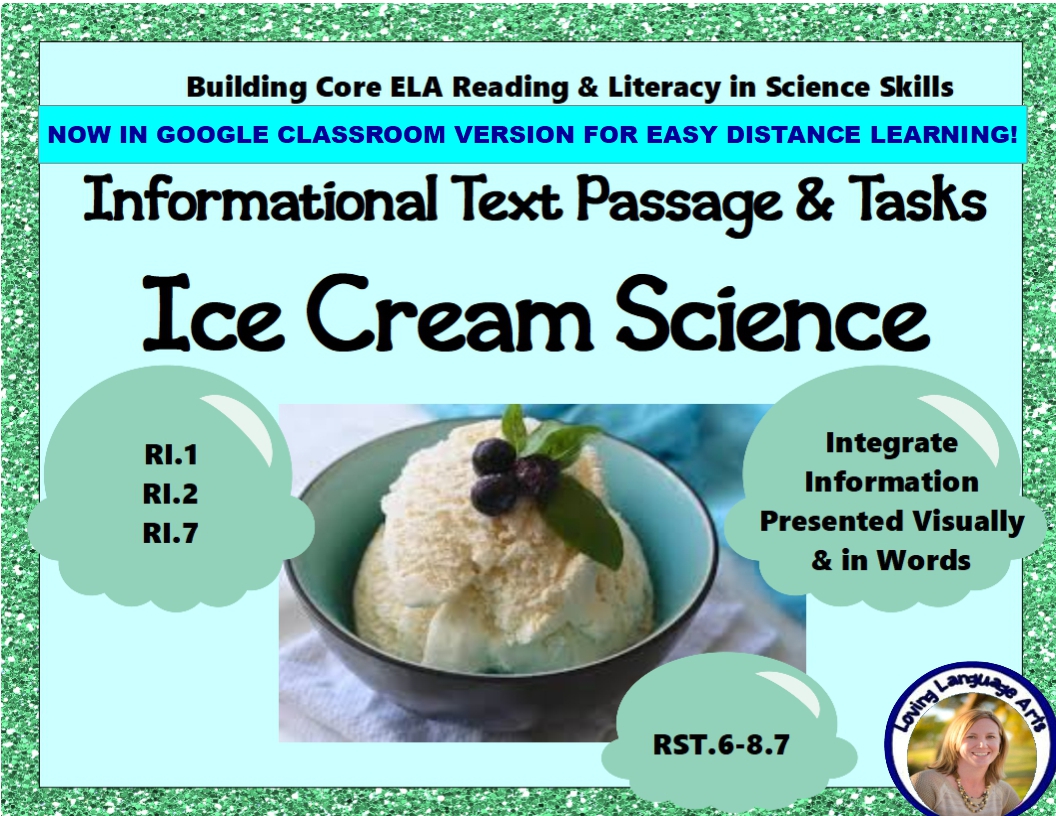
In my FUN-YET-EDUCATIONAL (AND CURRENTLY FREE) reading informational text and tasks lesson gets students to meet several standards for Literacy in Science & Technical Subjects and Writing, plus they have fun learning all about the science behind ice cream and the procedure for making their own ice cream.

In addition to summarizing central ideas, writing to explain the scientific procedure of how ice cream is made, writing a narrative about an ice cream incident, learning scientific vocabulary, citing evidence, getting the recipe for homemade ice cream in a baggie, and even doing a fun Mad Lib activity about ice cream, students fill out a graphic organizer like this in the free lesson:

You might also like these FREE items in the series. They all align to CCRA.R.7 and RST.6-8.7, which requires students to integrate quantitative or technical information presented in diverse media and formats, including visually (such as simulations, diagrams, videos, infographics) and quantitatively (such as tables, graphs, models, diagrams).

And, check out this COOL and FREE logic puzzle! It takes about 15 minutes of critical thinking, so it would be a good bellringer or free-time activity in any subject. For grades 4-9 more or less.

Since teaching ELA for 10 years, I’ve been a contracted learning resource and assessment writer while running my store “Loving Language Arts.” I know how to align to standards like the back of my hand, yet I always aim to make resources high-interest to motivate reluctant readers and writers.

Subscribe

Grade 4 Reading Passages and Practice Tests Workbook - Informational Text Edition
Grade 5 Reading Passages and Practice Tests Workbook - Informational Text Edition
Grade 6 Reading Passages and Practice Tests Workbook - Informational Text Edition
Grade 7 Reading Passages and Practice Tests Workbook - Informational Text Edition
Grade 8 Reading Passages and Practice Tests Workbook - Informational Text Edition
Grade 9 Reading Passages and Practice Tests Workbook - Informational Text Edition
Grade 10 Reading Passages and Practice Tests Workbook - Informational Text Edition
Grade 11 Reading Passages and Practice Tests Workbook - Informational Text Edition
Grade 12 Reading Passages and Practice Tests Workbook - Informational Text Edition
High School Bundle Reading Passages and Practice Tests Workbook - Informational Text Edition
Writing Modules General Promotion Pin

Subscribe

You Know What Else Kids Love?

These workbooks! I made the articles super interesting to kids by writing about things that interest them! AND IT WORKED! I keep hearing from teachers how kids get so into these texts that they actually WANT to answer the questions!

Click below for FREE ELA PRACTICE TESTS – each targeting specific reading, writing, language, and speaking/listening/viewing standards.

Check out these GRADE-SPECIFIC test prep books with practice tests that target EVERY GRADE-SPECIFIC READING INFORMATIONAL TEXT STANDARD, one by one. An added bonus is that students LOVE the texts! In Easy-Print or Self-Grading Online Versions.
Grade 4 Reading Passages and Practice Tests Workbook - Informational Text Edition
Grade 10 Reading Passages and Practice Tests Workbook - Informational Text Edition
Grade 5 Reading Passages and Practice Tests Workbook - Informational Text Edition
Grade 11 Reading Passages and Practice Tests Workbook - Informational Text Edition
Grade 6 Reading Passages and Practice Tests Workbook - Informational Text Edition
Grade 12 Reading Passages and Practice Tests Workbook - Informational Text Edition
Grade 7 Reading Passages and Practice Tests Workbook - Informational Text Edition
we sail for america by samuel mcclure ela practice test

Try a Freebie!

Grade 8 Reading Passages and Practice Tests Workbook - Informational Text Edition
be ready to help passage and ela practice test free

Try a Freebie!

Grade 9 Reading Passages and Practice Tests Workbook - Informational Text Edition
why onions make you cry passage and practice test

Try a Freebie!

The 6th Grade Practice Tests Test Prep Workbook “is a high quality, beautifully-aligned resource. It is no-frills, to the point, yet high-interest for students. It is helping us prepare for standardized testing in a hybrid, synchronous, difficult year.”

ReBeckha L.

Sixth Grade Teacher, Teachers Pay Teachers

How about save this pin to your “Literacy in Science” or “Creative ELA” Board so that you can come back to this post again?

blog header 5 cool facts about ice cream

Figurative Language Fun Reading and Writing

Figurative Language Fun Reading and Writing

Figurative Language Fun Reading and Writing

Who likes figurative language? Everybody does! (That’s hyperbole.) The great thing about it is you can say something is something it’s not and get away with it (using a metaphor)! When you’re at a loss for words, just use “like” or “as” to try to explain what you mean (with a simile). You can make words out of sounds like a teacher’s favorite “shhhhhh” (that’s onomatopoeia). Plus, listen to just about any song and you’ll hear figurative language because that’s how awesome it is!

blog post featured image figurative language fun

1. Let’s Start By Defining Some Common Figurative Language Terms:

  • personification: attributing human traits and qualities to something not human, such as an animal. I don’t think Disney could exist without this!
  • simile: a comparison that uses “like” or “as” such as “I’m as hangry as a bear.”
  • metaphor:something is said to be something else or do something else in order to suggest a similarity between them. Like, “You are such an angel!”
  • idiom: a commonly used phrase that isn’t meant to be taken literally because then it would make no sense! For example, “He kicked the bucket” has nothing to do with kicking a bucket. These are troublesome when you’re learning a language.
  • hyperbole:The use of exaggeration for emphasis or to create a strong impression
  • onomatopoeia:The formation of a word by imitation of a sound made by an object, person, or animal like “woof, woof.”
  • repetition/parallelism:Quite simply, repetition is the repeating of a word or phrase. It is a common rhetorical device used to add emphasis and stress in writing and speech.
  • alliteration: the occurrence of the same letter or sound at the beginning of adjacent or closely connected words. For example, the ice cream “Cocoa Mocha Macaroni”

2. Play Bingo Using Terms From This Comprehensive List: Holy smokes! This website defines a huge amount of figurative language and literary devices. I was thinking this could really help you if you want to make Literary Terms Bingo. For that you would make the bingo board with terms, and then instead of announcing the terms, you would announce the definitions. Sounds fun, right?

3. You’re a Mean One, Mr. Grinch: Ok, so I watched a LOT of videos online that attempted to teach figurative language, and I gotta say (sorry, but) they weren’t that great. I couldn’t recommend a single one. And then I got the idea to listen to the Christmas song about the Grinch and it’s perfect! You can have students watch the video and ask them to find similes, metaphors, and hyperbole. There are two similes right off the bat, and then metaphor galore, and also hyperbole such as “I wouldn’t touch you with a thirty-nine-and-a-half foot pole!” Here are the rest of the words:


You’re a mean one, Mr. Grinch

You really are a heel

You’re as cuddly as a cactus

You’re as charming as an eel

Mr. Grinch

You’re a bad banana

With a greasy black peel

You’re a monster, Mr. Grinch

Your heart’s an empty hole

Your brain is full of spiders

You’ve got garlic in your soul

Mr. Grinch

I wouldn’t touch you

With a thirty-nine-and-a-half foot pole

You’re a vile one, Mr. Grinch

You have termites in your smile

You have all the tender sweetness

Of a seasick crocodile

Mr. Grinch

Given the choice between the two of you

I’d take the seasick crocodile

You’re a foul one, Mr. Grinch

You’re a nasty, wasty skunk

Your heart is full of unwashed socks

Your soul is full of gunk

Mr. Grinch

The three words that best describe you

Are as follows and I quote, “Stink, stank, stunk”

You’re a rotter, Mr. Grinch

You’re the king of sinful sots

Your heart’s a dead tomato splotch

With moldy purple spots

Mr. Grinch

Your soul is an appalling dump heap

Overflowing with the most disgraceful assortment of deplorable

Rubbish imaginable

Mangled up in tangled up knots

You nauseate me, Mr. Grinch

With a nauseous super-naus

You’re a crooked jerky jockey

And you drive a crooked horse

Mr. Grinch

You’re a three-decker sauerkraut and toadstool sandwich

With arsenic sauce

Source: LyricFind/Songwriters: Albert Hague / Theodore S. Geisel/You’re a Mean One, Mr. Grinch lyrics © Sony/ATV Music Publishing
banner ad upper elementary ela resources


4. Song Lyrics: Song lyrics are PERFECT for finding figurative language. Ask students to share some examples, and they will be right on it!! Ask them to bring in lyrics and have the figures of speech already labeled and ready to share. And you may want to tell them to only bring in appropriate ones. Here are Kenny Chesney’s lyrics I love that aren’t really appropriate to share with kids (hypocrite?) but I want to share with you: “One bottle of wine, two dixie cups, three a.m. I fell in love, for the first time in my life.” Oh my goodness, I got chills again writing that.


5. It Came From Planet Simile Drawing Fun: Have students draw this creature, the creature from planet Simile.


planet simile drawing activity


6. Jack London’s stories, novels, and articles: This guy, in the early 1900s really knew his way around figurative language. For example, there’s “The Call of the Wild,” “To Build a Fire,” “Stories of the North,” “The Story of an Eyewitness,” etc. Or how about use this FREE lesson I made and you don’t even need the book for it. I did all the hard work of finding examples of figurative language in “The Call of the Wild” and then made a worksheet for kids to label them.


cover call of the wild figurative language lesson

banner ad new products for middle school ela

7. Alliteration Fun: Have you heard of Jack Prelutsky’s poem “Bleezer’s Ice Cream”? I just found it today and it’s not only a funny list of ice cream flavors, but it is also full of alliteration. Check it out:I made these graphic organizers using clip art from Erin Bradley Designs and am including them in my FREE CREATIVE GRAPHIC ORGANIZERS PACK (different colors and cone combinations). I think they would be perfect for listing some alliteration examples.


8. FREE Figurative Language Frenzy Webquest: I made this with distance learning in mind and some great short reading selections I know of that contain figurative language galore, such as “All Summer in a Day” and “There Will Come Soft Rains” by Ray Bradbury (which has the elusive, hard-to-find dramatic irony), Barack Obama’s 2008 acceptance speech which repeats “Yes we can,” Jack London’s article about the 1908 San Francisco Earthquake/Fire that appeared in Collier’s Magazine, and a modern-day article about the same event. You should get it for your students:


9. Which Simile Symbolizes Me?: Here’s ANOTHER FREE lesson I wrote, and this time it has to do with writing. It gets students to write similes about themselves and then do a related mandala art activity. It is available in Google Slides or PDF. You should check it out. You can see more samples done by kids of all ages in my blog post:

banner ad new products for high school ela

10. Bragging and Boasting Using Similes and Hyperbole Writing Activity: If you’re still reading, thank you for hanging in there! I give you yet again another FREE writing lesson that has always proven to motivate the most reluctant of writers and bring joy to the classroom (or home with Google Slides). It leads them step-by-step in writing about something they are okay at and making it sound like they are the best ever at it. You can see a sample in my blog post about it.


11. THREE MORE FREE READING LESSONS: These are for students to read “There Will Come Soft Rains“ and “All Summer in a Day“ by Ray Bradbury which are both packed with figurative language(and there’s me using Theresa Hernandez’s designs again). AND I made a WebQuest Practice Test “Smart Homes in Utopia and Dystopia” that engages students in reading multiple fiction and nonfiction online authentic sources around an awesome theme:


WebQuest Practice Test #4 Smart Homes in Utopia and Dystopia GIF

Since teaching ELA for 10 years, I’ve been a contracted learning resource and assessment writer while running my store “Loving Language Arts.” I know how to align to standards like the back of my hand, yet I always aim to make resources high-interest to motivate reluctant readers and writers.

Subscribe

Grade 4 Reading Passages and Practice Tests Workbook - Informational Text Edition
Grade 5 Reading Passages and Practice Tests Workbook - Informational Text Edition
Grade 6 Reading Passages and Practice Tests Workbook - Informational Text Edition
Grade 7 Reading Passages and Practice Tests Workbook - Informational Text Edition
Grade 8 Reading Passages and Practice Tests Workbook - Informational Text Edition
Grade 9 Reading Passages and Practice Tests Workbook - Informational Text Edition
Grade 10 Reading Passages and Practice Tests Workbook - Informational Text Edition
Grade 11 Reading Passages and Practice Tests Workbook - Informational Text Edition
Grade 12 Reading Passages and Practice Tests Workbook - Informational Text Edition
High School Bundle Reading Passages and Practice Tests Workbook - Informational Text Edition
Writing Modules General Promotion Pin

Subscribe

Click below for FREE ELA PRACTICE TESTS – each targeting specific reading, writing, language, and speaking/listening/viewing standards.

Check out these GRADE-SPECIFIC test prep books with practice tests that target EVERY GRADE-SPECIFIC READING INFORMATIONAL TEXT STANDARD, one by one. An added bonus is that students LOVE the texts! In Easy-Print or Self-Grading Online Versions.
Grade 4 Reading Passages and Practice Tests Workbook - Informational Text Edition
Grade 10 Reading Passages and Practice Tests Workbook - Informational Text Edition
Grade 5 Reading Passages and Practice Tests Workbook - Informational Text Edition
Grade 11 Reading Passages and Practice Tests Workbook - Informational Text Edition
Grade 6 Reading Passages and Practice Tests Workbook - Informational Text Edition
Grade 12 Reading Passages and Practice Tests Workbook - Informational Text Edition
Grade 7 Reading Passages and Practice Tests Workbook - Informational Text Edition
we sail for america by samuel mcclure ela practice test

Try a Freebie!

Grade 8 Reading Passages and Practice Tests Workbook - Informational Text Edition
be ready to help passage and ela practice test free

Try a Freebie!

Grade 9 Reading Passages and Practice Tests Workbook - Informational Text Edition
why onions make you cry passage and practice test

Try a Freebie!

The 6th Grade Practice Tests Test Prep Workbook “is a high quality, beautifully-aligned resource. It is no-frills, to the point, yet high-interest for students. It is helping us prepare for standardized testing in a hybrid, synchronous, difficult year.”

ReBeckha L.

Sixth Grade Teacher, Teachers Pay Teachers

How about save this pin to your “Figurative Language & Literary Devices” Board so that you can come back to this post again?

blog post featured image figurative language fun

10 Graphic Organizers for Reluctant Readers and Writers

10 Graphic Organizers for Reluctant Readers and Writers

10 Graphic Organizers for Reluctant Readers and Writers

Sometimes it just takes one simple thing to get reluctant readers and writers motivated to start their task. That one simple thing could be a fun, creative graphic organizer. So simple, yet so effective at getting them on board. Here are 10 different graphic organizers that do just that. 10, Wow!!! 


1. The Hamburger: Do an internet search and you will find a bunch of these. Some are for 1) planning to write a paragraph, 2) planning to write an essay, 3) planning to write a story, 4) identifying parts of a paragraph, 5) identifying parts of an essay, 6) identifying parts of a story. So many uses for a simple hamburger. Here is one I especially like by timvandevall.com:


sample graphic organizer for reading or writing grades 3-8


2. The Ice Cream Cone: I made these designs using clip art from Erin Bradley Designs. I use them for 1) to organize ideas about ice cream’s scientific properties that are explained in my info text/task lesson “Ice Cream Science,” 2) to write examples of alliteration from Jack Prelutsky’s poem “Bleezer’s Ice Cream,” (such as Cocoa Mocha Macaroni ice cream) or 3) writing ideas for a beginning, middle, and end. Thanks to Erin Bradley, I have ice cream scoops in lots of different colors and 4 types of cones, so the combinations seem endless.


In my FREE Graphic Organizers Pack, you can find these and more!


This is my FREE informational text and tasks lesson “Ice Cream Science” in which students use the organizers:


3. The Book Butterfly: I believe this is from Scholastic, but it is all over the internet, such as on Pinterest. It could be used with a fiction book, but with some tweaks could be used for informational text.


And, here’s what it looked like when it was younger lol:


banner ad upper elementary ela resources


4. Dogs: I have done a lot of informational texts/tasks and more on dogs. In fact, just today I added a reading analysis lesson honing in on themes “Aesop’s Fables Featuring Dogs“ and this lesson with 5 stories is FREE FOR THE SUMMER. I just think dogs are awesome and draw students putting them at ease. So I made these two graphic organizers using clip art from Dancing Author, Mary’s Clip Art, and Charlotte’s Clips. Students could read any of my FREE  high-interest informational texts about dogs and use these to write main ideas and key details. I’ll show you some of my products and then two of the organizers from my graphic organizers pack.


5 free dogs in society texts bundle


aesop's fables featuring dogs literary analysis activity


                              In my FREE Graphic Organizers Pack, you can find these and more!


5. My News Analysis: This looks like a nice, simple organizer for reading news articles.


6. Octo-Defense:


This one works well with finding central ideas in the National Geographic article about the Common Octopus, and more specifically, finding examples of the octopus’s defense mechanisms which the article explains well, making filing out this organizer pretty straightforward! It’s cute too.


banner ad new products for middle school ela


7. The Sundae: Again, another simple straightforward one which in this case is used for fiction, but could be adapted for nonfiction or writing, etc. It is from thedabblingspeechie.com.


8. Character Attribute Web: This one is from another blog post I did which shows how to use this to delve into Anne Frank’s character. I like it because it forces you to write evidence instead of general ideas.


                In my FREE Graphic Organizers Pack, you can find these and more!


I think it would work really well to analyze the character in “All Summer in a Day” by Ray Bradbury since the main character is developed quite thoroughly. So, I am including a link to that FREE lesson as well.


9. Flower Write: This looks like a versatile one that is for writing but could be used for reading or a lesson about flowers. It’s from Super Teacher Worksheets.


10. Roots: And finally, (are you still there?), I like how Cultivating Critical Readers organized prefixes and suffixes for a lesson about roots. I have seen this same concept using a tree and leaves for root words quite a bit. Usually the root word is at the bottom and then the leaves display words made from those roots.


banner ad new products for high school ela


BONUS I almost forgot: This is a great one to organize the thoughts and feelings of a character that you’ve read about or that you are going to write about. The one below is about Anne Frank. Check out the blog post with samples and a template.


Update: Since writing this post, I have created a free related product “Analyzing Characterization 6 Ways With 6 Graphic Organizers” and have written a blog post “Analyzing Characterization 6 Ways With 6 Different Charcters in 6 Stories” so check them out!

blog header analyzing characterization 6 ways in 6 stories with 6 characters

Since teaching ELA for 10 years, I’ve been a contracted learning resource and assessment writer while running my store “Loving Language Arts.” I know how to align to standards like the back of my hand, yet I always aim to make resources high-interest to motivate reluctant readers and writers.

Subscribe

Grade 4 Reading Passages and Practice Tests Workbook - Informational Text Edition
Grade 5 Reading Passages and Practice Tests Workbook - Informational Text Edition
Grade 6 Reading Passages and Practice Tests Workbook - Informational Text Edition
Grade 7 Reading Passages and Practice Tests Workbook - Informational Text Edition
Grade 8 Reading Passages and Practice Tests Workbook - Informational Text Edition
Grade 9 Reading Passages and Practice Tests Workbook - Informational Text Edition
Grade 10 Reading Passages and Practice Tests Workbook - Informational Text Edition
Grade 11 Reading Passages and Practice Tests Workbook - Informational Text Edition
Grade 12 Reading Passages and Practice Tests Workbook - Informational Text Edition
High School Bundle Reading Passages and Practice Tests Workbook - Informational Text Edition
Writing Modules General Promotion Pin

Subscribe

Click below for FREE ELA PRACTICE TESTS – each targeting specific reading, writing, language, and speaking/listening/viewing standards.

Check out these GRADE-SPECIFIC test prep books with practice tests that target EVERY GRADE-SPECIFIC READING INFORMATIONAL TEXT STANDARD, one by one. An added bonus is that students LOVE the texts! In Easy-Print or Self-Grading Online Versions.
Grade 4 Reading Passages and Practice Tests Workbook - Informational Text Edition
Grade 10 Reading Passages and Practice Tests Workbook - Informational Text Edition
Grade 5 Reading Passages and Practice Tests Workbook - Informational Text Edition
Grade 11 Reading Passages and Practice Tests Workbook - Informational Text Edition
Grade 6 Reading Passages and Practice Tests Workbook - Informational Text Edition
Grade 12 Reading Passages and Practice Tests Workbook - Informational Text Edition
Grade 7 Reading Passages and Practice Tests Workbook - Informational Text Edition
we sail for america by samuel mcclure ela practice test

Try a Freebie!

Grade 8 Reading Passages and Practice Tests Workbook - Informational Text Edition
be ready to help passage and ela practice test free

Try a Freebie!

Grade 9 Reading Passages and Practice Tests Workbook - Informational Text Edition
why onions make you cry passage and practice test

Try a Freebie!

The 6th Grade Practice Tests Test Prep Workbook “is a high quality, beautifully-aligned resource. It is no-frills, to the point, yet high-interest for students. It is helping us prepare for standardized testing in a hybrid, synchronous, difficult year.”

ReBeckha L.

Sixth Grade Teacher, Teachers Pay Teachers

How about save this pin to your “Reading” or “Graphic Organizers” or “Pre-Writing” Board so that you can come back to this post again?

character attribute web for reading literature activity pin