My Rule #1 for Teaching Elementary School

My Rule #1 for Teaching Elementary School

My Rule #1 for Teaching Elementary School

Attention! We all love it! Elementary-aged kids can’t get enough of it — mainly from adults (unlike middle and high school kids who care more about what their peers think than what you think). Positive attention. Negative attention. They’ll take whatever they can get! And, this is the tricky part…
blog post rule #1 for teaching middle school


Here’s the thing about elementary schoolers in particular:

They love attention from YOU! And, even negative attention is attention. Don’t fall into the trap, which can suck you in like quicksand — the trap of feeding your students negative attention. 

Trust me, I know how hard this is. I’ve messed this up so many times. I mean, sometimes they just seriously get on your nerves. They just drive you crazy! They break rules, talk back, misbehave. They know how to get your goat! Maybe they’re just acting the way they do at home where perhaps they’re used to getting yelled at and punished.

The thing is you can’t give them negative attention. I mean you can, but you shouldn’t. Whenever possible, give them positive attention instead.

The Goal is this, which is my #1 Rule for Teaching Elementary School: Give them the attention they crave

 

middle school of students

When the quicksand sucks you in, and you’ve fallen into the trap, you’re inadvertently filling the space inside the four walls of your classroom with negative energy. First, it emanates from you. Then, it spreads! Like wildfire. Or dominoes. No wonder you feel so drained at the end of the day! (Ok, that’s not the only reason you’re drained, but negativity just leaves you feeling icky).

Sure, you need to discipline. You have high standards, as you should. You need to provide consequences. Logical ones. For your mental health and theirs, discipline calmly, not when you’re frustrated or angry. (Maybe sit down and take some deep breaths when you’re seeing red.) And follow my tips in this blog post for providing positive attention.
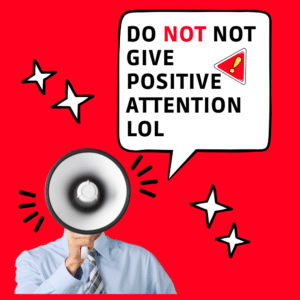
symbol of no power struggles


Here are some ideas for giving positive attention:

  • Praise Positive Behavior:  It’s true that you expect them to do as they’re told and behave, so you may wonder why this is necessary. It’s necessary because kids LOVE it, and they’ll actually stay the course versus get off track. Plus, it gets other students envious, and they’ll try to get the same praise. Go overboard. Say it out loud. My favorite is “I like the way so-and-so is doing so-and-so. Way to go!” or “Thank you for putting your phone in the holder; I really appreciate that!” or “Wow, your handwriting is so neat! I love it, and I can easily read it!” or “That paragraph is so well written! Dang, I am impressed – topic sentence, transition words, details, evidence – that is so awesome!” Yes, go overboard, even if it feels weird to praise what you already expect anyway.
  • Notice Something They Put Effort Into and Compliment It (something superficial is just fine): Do you like their shoes? Their shoelaces? Their new haircut? Their backpack? Their nails, jewelry, accessories? Their squishy toy? It’s ok if it feels superficial! The art project they made? Their notebook cover? Their lunch/snack choice? How they helped or volunteered? How neatly they wrote? How they sang? Danced? Played an instrument? Performed athletically? Performed in the play? Colored a picture? TELL THEM! And, challenge yourself to especially do this for a frequent misbehaver (before they misbehave is being proactive) even if it feels weird. Compliments like these go a long way. Don’t worry about others feeling bad; they won’t. And, try to do this with everyone over time.
  • Be an ACTIVE Listener: Students want to be heard. They sometimes overshare. They tell long stories. They say the weirdest things. They tell you how they feel. They tattle tell. If they are talking to you, don’t just hear them while you multitask. Actively listen, which means: maintain eye contact, repeat back/clarify some part of what they said (“So what you’re saying is…), ask leading questions (“And how did that make you feel?”), ask any related questions, don’t multitask, don’t cut them off or interrupt. Ok, this can be challenging when they go on and on using way too many words and descriptions, or when you honestly just don’t care, or if they are being a Negative Nelly, or tattling — just try to hear them out. You can get them to speed up or get them to realize what they’re actually saying behind the cryptic talk, by telling them you’re so sorry, but you have such-and-such to do/don’t have much time, or by asking clever, leading questions that get them to reflect on themselves instead of talking about other people.
  • Greet Them at The Door By Name: And why not add a fist bump, personalized comment, or words of praise…or “Nice to see you.”
  • Use Popsicle Sticks to Include Everyone: Call on them randomly, and rotate through all of them to answer questions or do tasks for  you. Otherwise, the quiet ones can just slide under your radar and hardly get any attention while the squeaky wheels or zealous participators steal all the attention.
  • Make Positive Phone Calls Home or Send Home Positive Notes: Make them quick, specific, and easy or you’ll get burnt out trying to keep it up. Maybe use a template and just fill in their name with one sentence.
  • Smile
  • Laugh
  • Joke Around
  • Play With Them/Join in the Fun
  • Bond With Them Over Low-Key Stuff: My go-to low-key topic is pets. “Do you have any pets? What kind? What is its name? How long have you had it?” etc. And, “I have two cats: one is named Puffin and the other is Muffin! They’re siblings. They do some funny things, such as…Do your pets do silly things?” Another great topic is video games/games in general. “I LOVE Candy Crush. Do you? What’s your high score? Wow!” Also, I am in LOVE with Squishies! The same ones kids love. “I LOVE your squishy! That is so cute! Where did you get it?” etc.
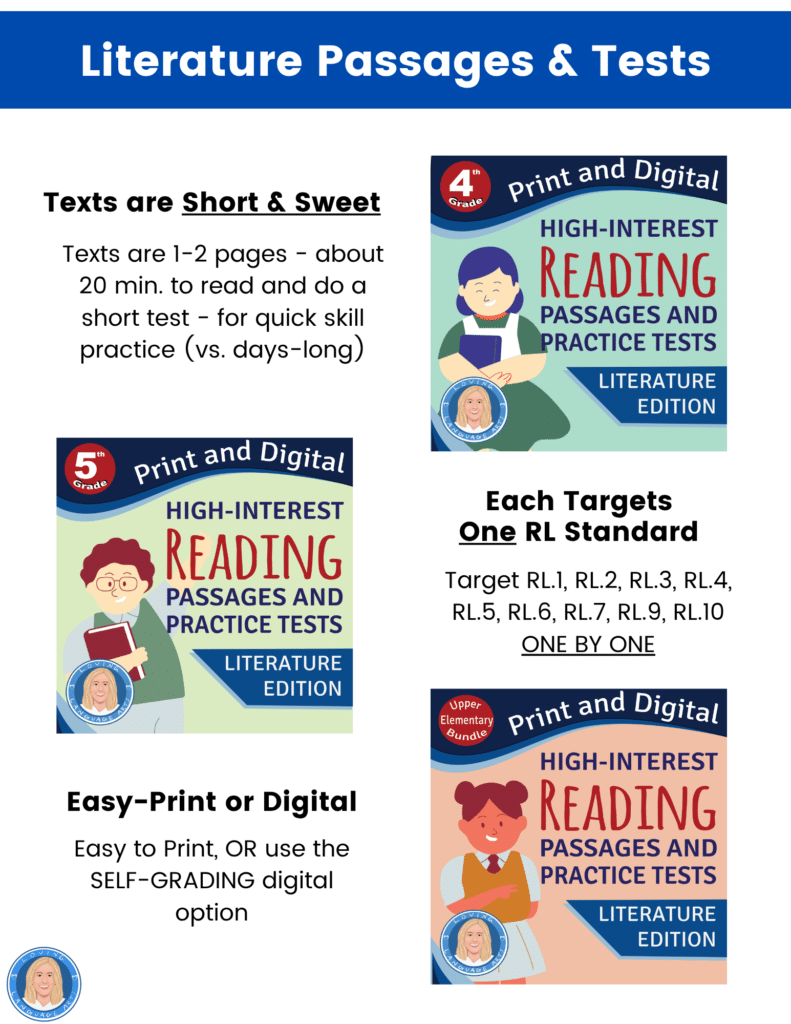
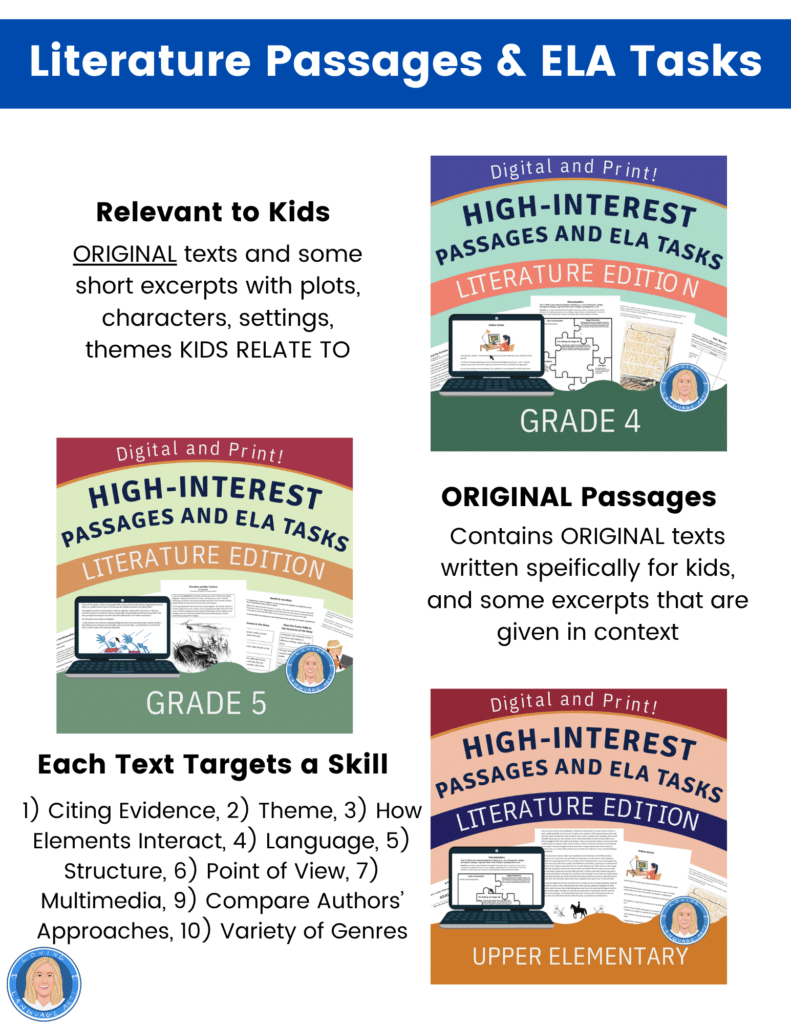
Here’s another trick I learned. When you provide your students with high-interest learning resources they feel are relevant to them and interesting in some way, they will actually behave better. They will get sucked into whatever you are trying to get them read, write, or do and forget about misbehaving.

So, that’s why I created these short and sweet (many of which are ORIGINAL, written by human authors I employed, mixed in with some great classics), high-interest Literature Skills Workbooks. They come in two versions: “Reading Literature Passages and ELA Tasks” and “Reading Literature Passages and Practice Tests”.

I went out of my way to make the literature (fictional narratives/short stories, poems, memoirs, song lyrics) super interesting to students by writing about characters, settings, conflicts that interest them.  Plus, unlike the textbooks and even online sources, I purposely made them short (one to two pages) for quick, painless skill practice that is also easy to print (online versions are included, including self-grading tests).

And, guess what? It worked. I’ve been hearing from teachers how kids get so into these passages. They actually WANT to answer the questions. They even want to discuss the literature as a group. 
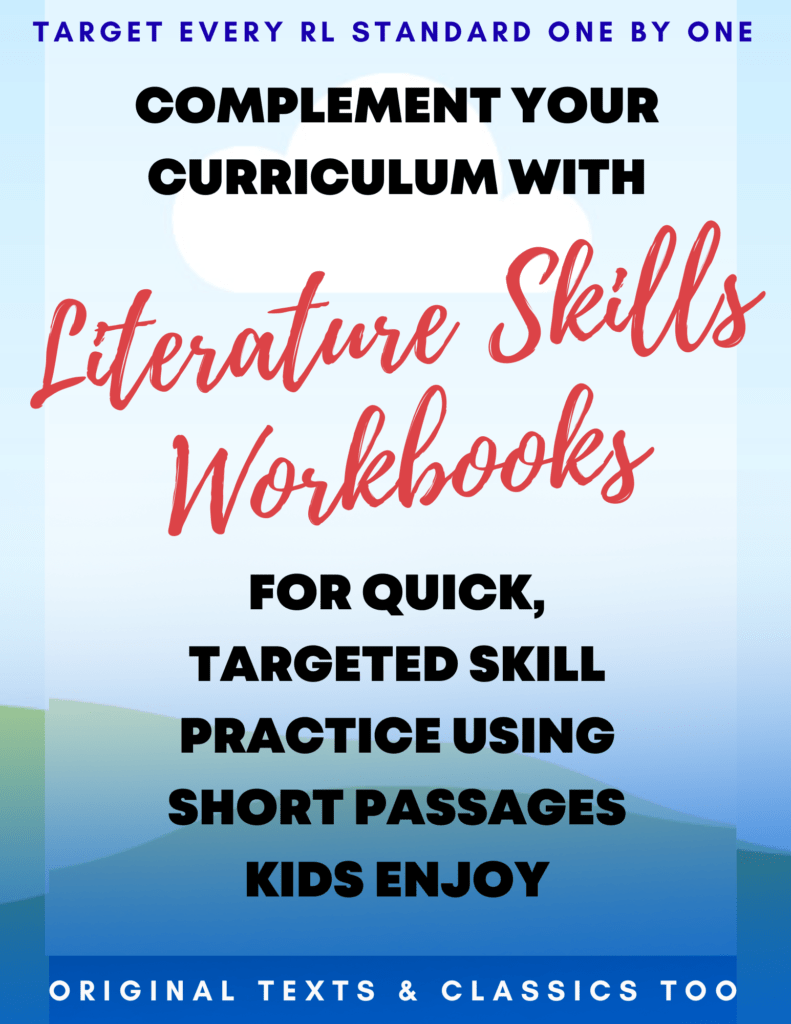
link to literature skills workbooks for grades 4-12

And teachers keep reporting how much time and hassle I have saved them. I did that by aligning every text and task to a specific Reading Literature Standard and did that 9 times to cover all 9 of them individually (There is no RL.8). Now teachers don’t have to go searching for the right passages that bring out the right skills.

The unique thing about these workbooks is that students are guided to focus on one RL Standard at a time, one by one. And, they are NO PREP!

Find the Literature Skills Workbook for the grade(s) you teach, and use them all year long! Your students are actually going to behave better because they won’t be bored!

how my literature skills workbooks solve problems for ELA teachers

I even made them in both PDF and interactive Google Slides and self-grading Forms, in case you want the easy digital option!
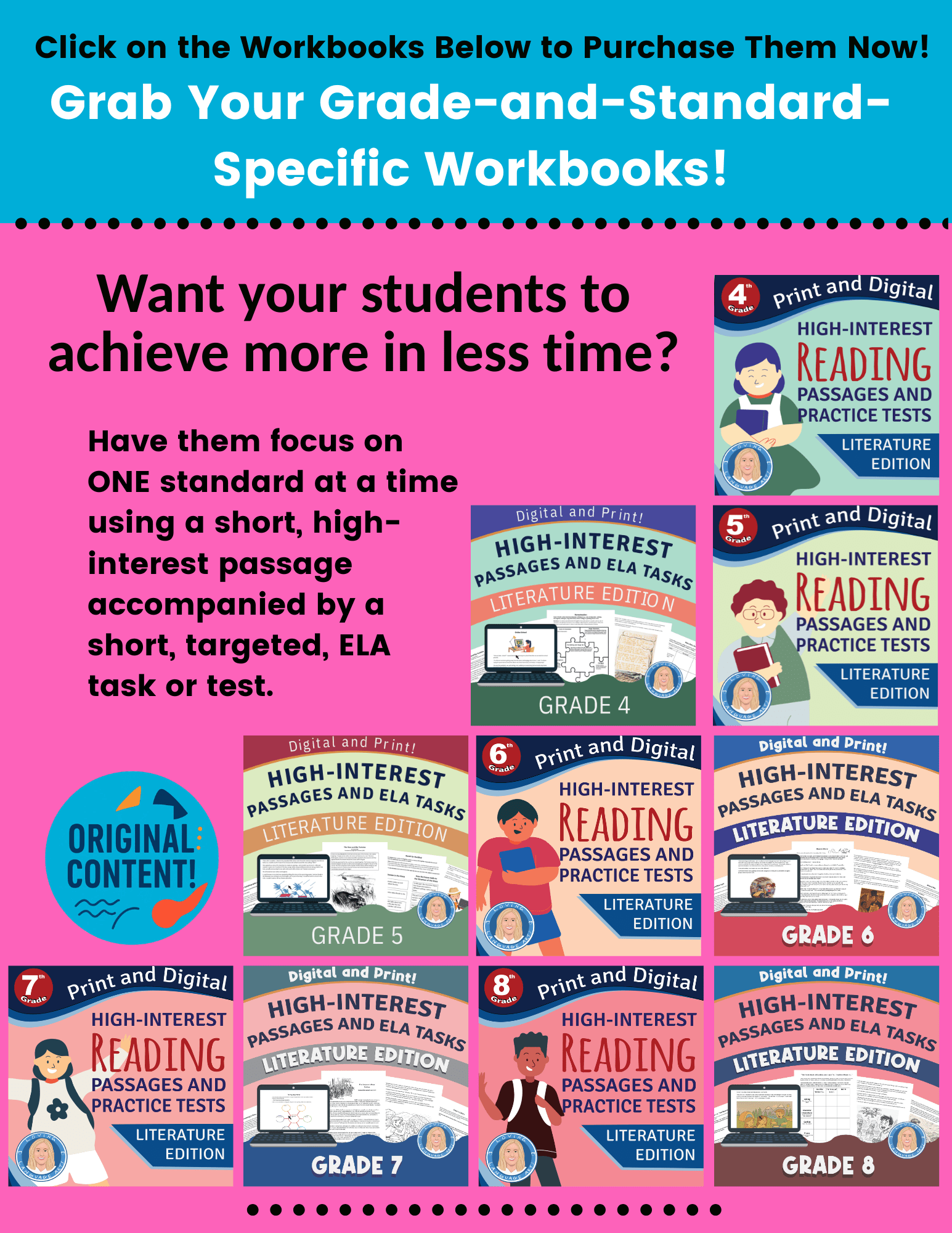
banner ad new products for middle school ela
save yourself hours of internet searches promo
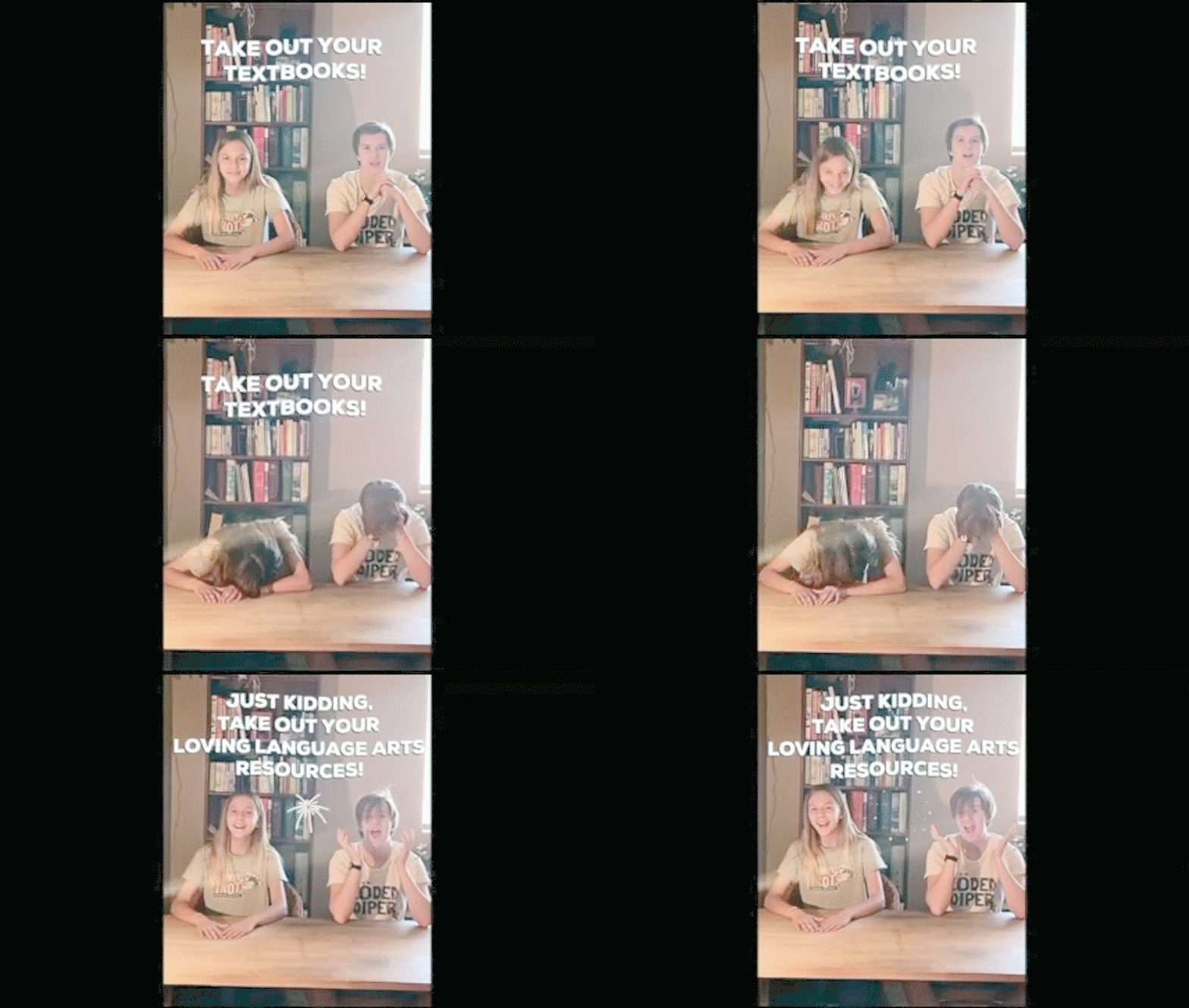
GIF showing kids who hate textbooks but love using Loving Language Arts resources

Since teaching ELA for 10 years, I’ve been a contracted learning resource and assessment writer while running my store “Loving Language Arts.” I know how to align to standards like the back of my hand, yet I always aim to make resources high-interest to motivate reluctant readers and writers.

Subscribe

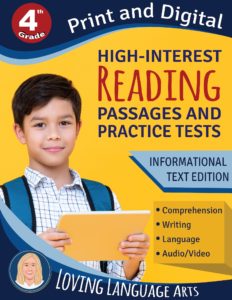
Grade 4 Reading Passages and Practice Tests Workbook - Informational Text Edition
Grade 5 Reading Passages and Practice Tests Workbook - Informational Text Edition
Grade 6 Reading Passages and Practice Tests Workbook - Informational Text Edition
Grade 7 Reading Passages and Practice Tests Workbook - Informational Text Edition
Grade 8 Reading Passages and Practice Tests Workbook - Informational Text Edition
Grade 9 Reading Passages and Practice Tests Workbook - Informational Text Edition
Grade 10 Reading Passages and Practice Tests Workbook - Informational Text Edition
Grade 11 Reading Passages and Practice Tests Workbook - Informational Text Edition
Grade 12 Reading Passages and Practice Tests Workbook - Informational Text Edition
High School Bundle Reading Passages and Practice Tests Workbook - Informational Text Edition
Writing Modules General Promotion Pin

Subscribe


Check out these GRADE-SPECIFIC workbooks with ELA tasks or practice tests that target EVERY GRADE-SPECIFIC READING LITERATURE TEXT STANDARD, one by one. An added bonus is that students LOVE the texts! In Easy-Print or Self-Grading Online Versions.
Grade 4 Reading Passages and Practice Tests Workbook - Informational Text Edition
Grade 10 Reading Passages and Practice Tests Workbook - Informational Text Edition
Grade 5 Reading Passages and Practice Tests Workbook - Informational Text Edition
Grade 11 Reading Passages and Practice Tests Workbook - Informational Text Edition
Grade 6 Reading Passages and Practice Tests Workbook - Informational Text Edition
Grade 12 Reading Passages and Practice Tests Workbook - Informational Text Edition
Grade 7 Reading Passages and Practice Tests Workbook - Informational Text Edition
we sail for america by samuel mcclure ela practice test
Grade 8 Reading Passages and Practice Tests Workbook - Informational Text Edition
be ready to help passage and ela practice test free
Grade 9 Reading Passages and Practice Tests Workbook - Informational Text Edition
why onions make you cry passage and practice test

"My students absolutely LOVE these! They were asking for more! Thank you!"

Paula R.

Seventh Grade Teacher, Teachers Pay Teachers

How about save this pin to your Pinterest boards so that you can come back to this post again?

Black History in ELA blog post pin

Patriot Day in ELA

Patriot Day in ELA

Patriot Day in ELA

As an English language arts teacher, you are in a unique position to help students process and understand why we observe Patriot Day and what happened on September 11, 2011 by having them: read informational texts, read first-hand accounts, poetry, fiction, and more; write in a variety of genres (critical thinking); explore the difference between accurate, reliable sources/accounts and garbage (stereotypes, false claims, sensationalism); explore themes such as courage and resilience; and, analyze language such as rhetoric and vocabulary. That’s what I love about ELA! We are here to guide critical thinking, not just lay facts on them. I believe critical thinking might be the most important thing we can facilitate in our classrooms today. Help students discover accurate historical context without overwhelming them with graphic details or images. Focus on remembrance, community, and the facts.

Black History in ELA Blog Post Header


1. Write a cause-and-effect essay: The fact of the matter is that September 11, 2001 became a catalyst for changes: creation of Homeland Security, increased surveillance (cameras, facial recognition, access to “private” cell phone data, etc.), changes to privacy rights, creation of the TSA in airports (Transportation Security Administration), broken families, loss of loved ones, shaking up our sense of stability and security, and more. Have students give some factual background on some aspect of the 9/11 terrorist attacks (the cause), and use transition words/phrases to explain what changed as a result, and how (the effect). You should have students evaluate sources for accuracy and credibility, and then cite them as text evidence.

2. Write an explanatory essay: I was actually teaching middle school ELA on 9/11/01, and I was at a loss for words of how to quickly, accurately, and objectively explain what was happening. It would have been helpful to have a premade paragraph. Have students imagine they have children their age and have to explain it to them. Just the facts! No emotions, no stereotypes, no sweeping generalizations, no racism, no misinformation. What happened – who, what, where, when, how, why? Just have them explain the facts. 

banner ad upper elementary ela resources


3. Jigsaw groups to explore 9/11 poetry: Direct students to https://www.poetryfoundation.org/categories/september-11th?sectionHandle=poems and assign different poems to students. Have students sit in small groups. Each student reads their selected poem. They have a short discussion about what it means, its symbolism, etc. before moving on to the next one.


march on washington 1963 button

4. Explore Impactful Vocabulary: Have students make a simple bubble map with a circle in the middle and four bubbles attached with prongs. In the circle in the middle, have students write the vocabulary word, and its definition. In the four bubbles, have students write examples of ways people showed or show this quality in regards to September 11th or Patriot Day. Here are some ideas for words: courage, resilience, remembrance, regrowth, security, recovery.

5. Compare and contrast primary source first-hand accounts: Direct students to this credible website which features vetted firsthand accounts of September 11, 2001 at or near Ground Zero: https://911groundzero.com/firsthand-accounts/. The collection is called “We are New Yorkers with personal connections to the events of September 11, 2001.” Have students select two of the firsthand accounts, and write a compare-and-contrast essay about the similarities and differences between their experiences, or even the tone/attitude and language they use. Students should quote text evidence, and explain it. 


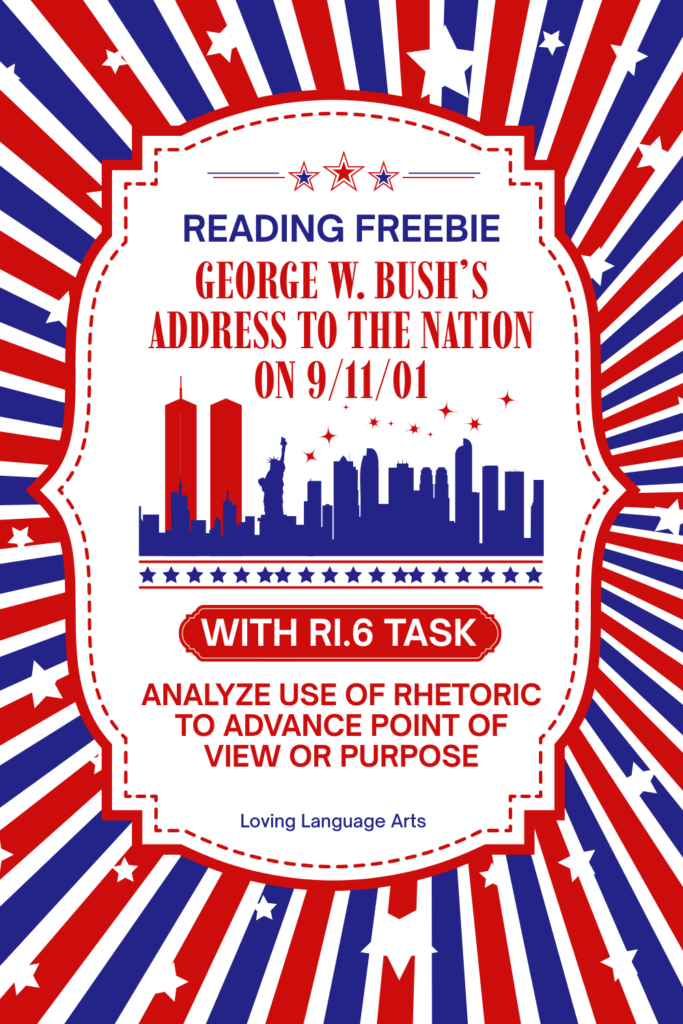
6. Use this Reading Freebie: I created what I think is an awesome reading freebie: Analyzing Rhetoric to Advance Purpose or Point of View in President George W. Bush’s Address to the Nation on 9/11/01. FREE Reading an Informational Text with an ELA Task aligned to RI.6 (Analyze rhetoric to advance purpose or point of view): I like that it is short and sweet; the speech is only ONE PAGE and the task is only ONE PAGE, making it easy to print if desired. There is also an interactive Google Slides version as well. This lesson is included in the Reading Informational Text Workbook for Grade 10, but it can be used in various grades.

It has students analyze use of:

  • figurative language
  • allusion to and quote from the Bible
  • anaphora
  • antithesis
  • tone
  • appeals to audience
  • claims and whether they are credible
  • other rhetorical devices such as descriptive adjectives and metaphors
  • point of view
  • author’s purpose

It is aligned to these standards:

  • RI.9-10.6 (Determine an author’s point of view or purpose in a text and analyze how an author uses rhetoric to advance that point of view or purpose.)
  • RI.6 for grades 6, 7, 8, 9, 10, 11, 12 (Assess how point of view or purpose shapes the content and style of a text.)
  • RI.9-10.9 Analyze seminal U.S. documents of historical and literary significance (e.g., Washington’s Farewell Address, the Gettysburg Address, Roosevelt’s Four Freedoms speech, King’s “Letter from Birmingham Jail”), including how they address related themes and concepts.
  • RI.9-10.8 (Delineate and evaluate the argument and specific claims in a text, assessing whether the reasoning is valid and the evidence is relevant and sufficient; identify false statements and fallacious reasoning.)
  • RI.8 for all grades (Delineate and evaluate the argument and specific claims in a text, including the validity of the reasoning as well as the relevance and sufficiency of the evidence.
  • RI.1 for all grades (Read closely to determine what the text says explicitly and to make logical inferences from it; cite specific textual evidence when writing or speaking to support conclusions drawn from the text.)
  • L.5 for all grades (Demonstrate understanding of figurative language, word relationships, and nuances in word meanings.)

Please save this pin to your Pinterest boards, so you can access it easier, year after year:


Check out these GRADE-SPECIFIC workbooks with ELA tasks or practice tests that target EVERY GRADE-SPECIFIC READING LITERATURE TEXT STANDARD, one by one. An added bonus is that students LOVE the texts! In Easy-Print or Self-Grading Online Versions.
Grade 4 Reading Passages and Practice Tests Workbook - Informational Text Edition
Grade 10 Reading Passages and Practice Tests Workbook - Informational Text Edition
Grade 5 Reading Passages and Practice Tests Workbook - Informational Text Edition
Grade 11 Reading Passages and Practice Tests Workbook - Informational Text Edition
Grade 6 Reading Passages and Practice Tests Workbook - Informational Text Edition
Grade 12 Reading Passages and Practice Tests Workbook - Informational Text Edition
Grade 7 Reading Passages and Practice Tests Workbook - Informational Text Edition
we sail for america by samuel mcclure ela practice test
Grade 8 Reading Passages and Practice Tests Workbook - Informational Text Edition
be ready to help passage and ela practice test free
Grade 9 Reading Passages and Practice Tests Workbook - Informational Text Edition
why onions make you cry passage and practice test

“My students absolutely LOVE these! They were asking for more! Thank you!”

Paula R.

Seventh Grade Teacher, Teachers Pay Teachers

How about save this pin to your Pinterest boards so that you can come back to this post again?

Black History in ELA blog post pin

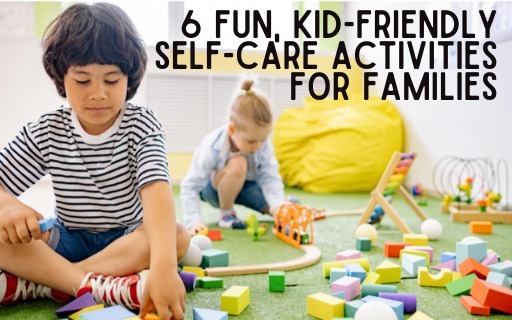
6 Fun, Kid-Friendly Self-Care Activities for Families

6 Fun, Kid-Friendly Self-Care Activities for Families

6 Fun, Kid-Friendly Self-Care Activities for Families

I am so excited to host my first guest blogger here at lovinglanguagearts.com. I am thrilled that a fellow like-minded, health-and-family-oriented blogger named Anya actually asked me to host her awesome post all about how families can (and should) indulge daily in self-care activities. Anya Willis is a mother of three and has been a yoga instructor for the past 12 years. She created FitKids.info to help parents find fitness alternatives to keep their kids moving.

Anya Willis Post family-friendly self-care activities

Are you concerned that your children seem anxious or stressed? Stress can affect even young children, and with the many challenges that people of all ages have dealt with over the past few years, it’s no wonder that so many kids need more support. With resources from Loving Language Arts, you can help your children succeed academically. Additionally, here are several self-care tips to help them feel their best at home, too!

Create an Organized Schedule

Time management goes hand-in-hand with self-care. If your household feels chaotic, and your family lacks a structured routine, it’s time to implement a predictable schedule. This is especially important if you’re a parent who works from home, as this can make it easier to balance your professional responsibilities with your children’s needs. Put up a clear schedule in your kitchen or by your front door so that everyone can see it!

Become a ‘Self-Care’ Role Model

If you want your children to understand the importance of self-care, you need to model these habits for them. Remember, kids will often try to imitate the adults around them, so aim to set a good example! Spend time with your kids while doing relaxing activities, like reading a book, playing a board game, taking a walk around the neighborhood, hanging out on the front porch, or even napping! Help your children define their own “self-care.”

And don’t forget to spend a little time taking care of yourself as well. Once the kids have gone to bed for the night, don’t feel guilty about soaking in a bubble bath, relaxing on the couch with a good TV series, practicing yoga or meditation, or simply sitting down and having a great conversation with your partner.

Reduce Screen Time

As schools shifted to remote learning, there’s a high chance that your children spent more time looking at screens than ever before. You may be concerned about their screen time. If you want to help your children cut back on their screen time, Very Well Family recommends establishing “technology-free” zones in your house, where your family can enjoy screen-free activities.

Plan Outdoor Play Dates

With the rise of remote learning, you might also worry about how much your child is socializing offline. It’s important for young children to spend lots of time socializing with other kids so that they can learn good manners, figure out how to get along with others, and make their first friends!

To help your kids cut down on screen time and socialize again, you can plan some outdoor play dates with their classmates. Getting outside more often with friends can help your kids find some joy during difficult times, and exercising is also beneficial for their mental health.

Focus on Good Nutrition

Did you know that your child’s diet can actually affect their ability to focus and succeed in school? Eating a balanced diet can help your child concentrate during classes, remember what they’ve learned, and apply those skills to achieve better grades. Learning Lift Off states that children can benefit from starting the day with a breakfast that includes whole grains and proteins, eating lots of whole foods instead of processed foods, and choosing healthy snacks like fruits and veggies.

Age-Appropriate Meditation

Perhaps you’ve tried meditation before and felt like you benefited from the practice – but it might be hard to imagine your child sitting still to meditate! However, it might come as a surprise to hear that meditation is for kids, too. Of course, there are a few things you can do to make meditation feel more engaging for young children. If you’d like to encourage your kids to meditate, you can create a cozy “mindfulness space” in your home complete with meditation cushions, tell your kids a story to help them practice visualization, and even download a meditation app specifically designed for kids.

Just as adults need time to unwind and relax, self-care is essential for kids, too! These self-care tips are fun and engaging for younger and older kids! By taking time to de-stress as a family, you can help your children feel happier and healthier.

Looking for language arts resources your kids will love? Find the tools you need through Loving Language Arts! Browse our website today for ideas, freebies, and resources.

Photo via Pexels

CHECK OUT WRITING MODULES

I’m excited to introduce you to my new product line: “Writing Modules.” The writing modules are writing assessment test prep that get students to practice writing in all different genres. The writing is text evidence-based and comes with several sources for students to cite. This is no-prep and includes everything they (and you) need including rubric, scoring sheet, graphic organizer, and more.

Each Writing Module comes in two levels: Grades 4-6 and Grades 7-12.

ad for writing modules writing test prep

How about save this pin to your “self-care ideas” or “activities for kids to unwind” board so that you can come back to this post later?

pin for blog post by Anya Willis 6 fun kid-friendly self-care activities for families

Since teaching ELA for 10 years, I’ve been a contracted learning resource and assessment writer while running my store “Loving Language Arts.” I know how to align to standards like the back of my hand, yet I always aim to make resources high-interest to motivate reluctant readers and writers.

Subscribe

Grade 4 Reading Passages and Practice Tests Workbook - Informational Text Edition
Grade 5 Reading Passages and Practice Tests Workbook - Informational Text Edition
Grade 6 Reading Passages and Practice Tests Workbook - Informational Text Edition
Grade 7 Reading Passages and Practice Tests Workbook - Informational Text Edition
Grade 8 Reading Passages and Practice Tests Workbook - Informational Text Edition
Grade 9 Reading Passages and Practice Tests Workbook - Informational Text Edition
Grade 10 Reading Passages and Practice Tests Workbook - Informational Text Edition
Grade 11 Reading Passages and Practice Tests Workbook - Informational Text Edition
Grade 12 Reading Passages and Practice Tests Workbook - Informational Text Edition
High School Bundle Reading Passages and Practice Tests Workbook - Informational Text Edition
Writing Modules General Promotion Pin

Subscribe

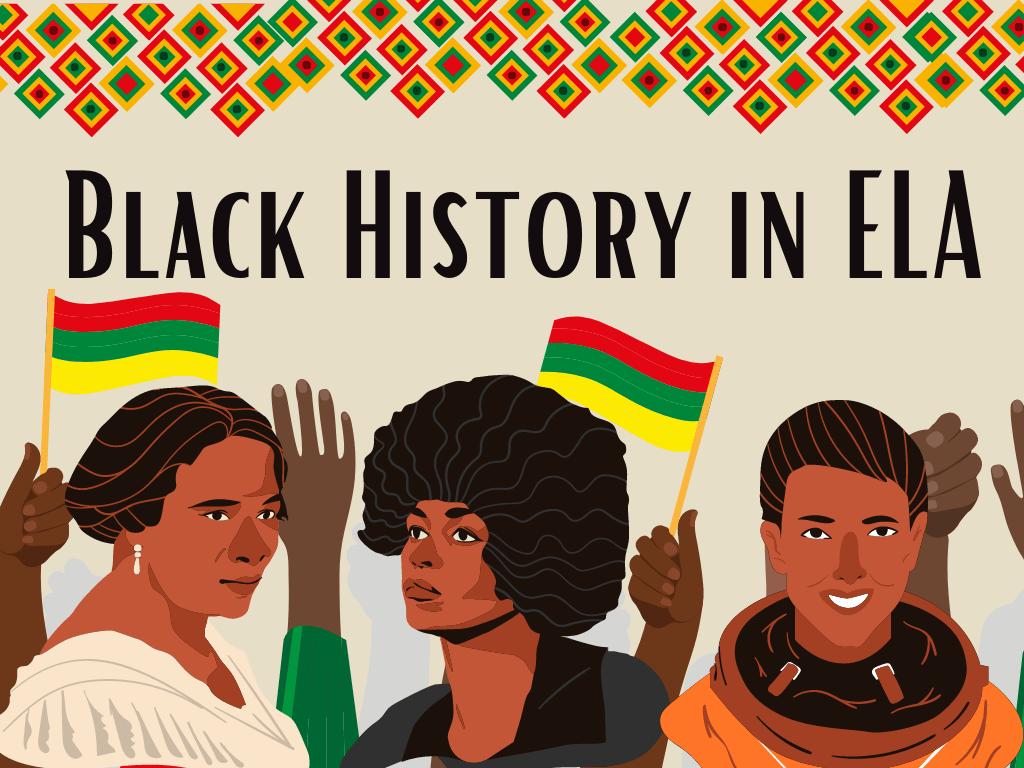
Black History in English Language Arts

Black History in English Language Arts

Black History in English Language Arts

Black history is our history. It’s not some separate history to marvel. It’s not a gimmick to gawk at in February. Still, while it’s somewhat disappointing that it takes Black History Month to draw attention to Black History, it’s also a blessing to have this opportunity in English language arts.

Getting students reading, writing, and analyzing rhetoric by or about Black authors will likely spark something inside of them that will simmer, and – hopefully at the right times – enflame inside of them, throughout their entire lives. When your heart is touched by powerful rhetoric, it stays with you forever. You can’t ever forget the truth when it’s described so passionately. And, when you apply the lessons to your own life, it becomes wisdom.

So, here are 10 ideas for teaching Black History in ELA –  your chance to get students reading, writing, analyzing, and most important – feeling – about our history, Black History.

Black History in ELA Blog Post Header


1. Journal Writing About Famous Quotes in Black History: As a bellringer or a 10-minute “quick write” session, have students respond to the Black History quote of the day you give them. How about do this all throughout February since there are so many good quotes? For example, “Never be limited by other people’s limited imaginations” (Dr. Mae Jemison, first African-American female astronaut) or “The cost of liberty is less than the price of repression” (W.E.B. DuBois), or “The time is always right to do what it right” (Martin Luther King, Jr.), or here’s 117 more Black History quotes you can use!

2. Divi Up & Jigsaw the Plethora of Topics: When you go looking for what to teach in Black History, it’s a bit like trying to get a drink from a fire hydrant blasting out water. There are so many influential figures, movements, & accomplishments. So, how about have each student select a different figure or topic to write a research report or presentation about? Another option is jigsaw groups. This is where you assign small groups topics such as “Black athletes” and then the members of the group each research and report back on something specific, such as Jackie Robinson, Michael Jordan, and Serena Williams. Then, the groups present to the class (hopefully in an interesting way. See this post for 10 Great Ways to Research & Present Information. ) Here are some of the many ideas:

  • Notable Historical Figures & Institutions: Harriet Tubman, Frederick Douglass, Booker T. Washington, W.E.B. DuBois, Martin Luther King, Jr., Thurgood Marshall, John Lewis, Sojourner Truth, Mary McLeod Bethune (Bethune-Cookman College), the Underground Railroad, the Mason-Dixon Line, Howard University, the Green Book, and more
  • Figures in Science & Technology: Rebecca Lee Crumpler, Daniel Hale Williams, George Washington Carver, Bessie Coleman, Katherine Johnson, Percy Julian, Mae Jemison, Warren Washington, Benjamin Banneker, and more
  • Performers, Musicians, & Actors: Louis Armstrong, Marian Anderson, Teddy Wilson, Hattie McDaniel, Sidney Poitier, Octavia Butler, Denzel Washington, Beyonce and Jay-Z, Muddy Waters, Oprah Winfrey, and more
  • Athletes: Jesse Owens, Jackie Robinson, Althea Gibson, Wilma Rudolph, Hank Aaron, Bill Russell, Jackie Joyner-Kersee, Michael Jordan, Serena & Venus Williams, LeBron James, Simone Biles, Arthur Ashe, Kobe Bryant, and more
  • Military & Government Figures: Buffalo Soldiers, Tuskegee Airmen, Colin Powell, Condoleezza Rice, Barack Obama, Thurgood Marshall, FDR’s “Black Cabinet,” and more
  • Civil Rights Topics & Leaders: Brown v. Board of Education, Montgomery Bus Boycott, Lunch Counter Sit-ins, Selma to Montgomery Marches, Civil Rights Act, Voting Rights Act, Black Lives Matter Movement, Rosa Parks, The March on Washington, Assassination of MLK, Ruby Bridges, Claudette Colvin, Jim Crow Laws, “separate but equal,” Jesse Jackson, NACW, NAACP, nonviolent protest, and more
  • Writers: Maya Angelou, James Baldwin, Langston Hughes, Zora Neale Hurston, Toni Morrison, and more
banner ad upper elementary ela resources
 

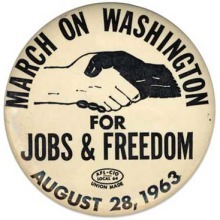
3. Make Modern-Day Civil Rights Posters, Buttons, or Inspirational Quote Posters: Have students look at images of civil rights posters, such as these Freedom Movement posters. Or, simply Google “civil rights posters” and you’ll see a ton of great ones, old and new, come up. Then, have students Google “civil rights buttons” or visit this collection of political buttons, which are visual symbols showing that the wearers are fighting for some cause. Next, have students make modern-day civil rights posters or buttons, each containing one simple slogan about what we should strive for or specifically do to advance civil rights in some way. BUT BE CAREFUL. You should require that the posters be peaceful in nature, non-offensive, non-aggressive…set whatever boundaries you like to keep this activity peaceful.

march on washington 1963 button
modern day civil rights poster
Steve.fami.ly, CC BY-SA 4.0 <https://creativecommons.org/licenses/by-sa/4.0>, via Wikimedia Commons


Or maybe just have them do this less passion-provoking art instead: have each student write an inspirational quote on a posterboard, and decorate it to hang in the room. Or, have students make a poster promoting Black History Month. If you don’t want to display the artwork on the walls, you can have students do a “gallery walk” in which students walk around the class to view each other’s creations. Here are links to 120 Black History quotes or a list of 25 Quotations by MLK for the Classroom.

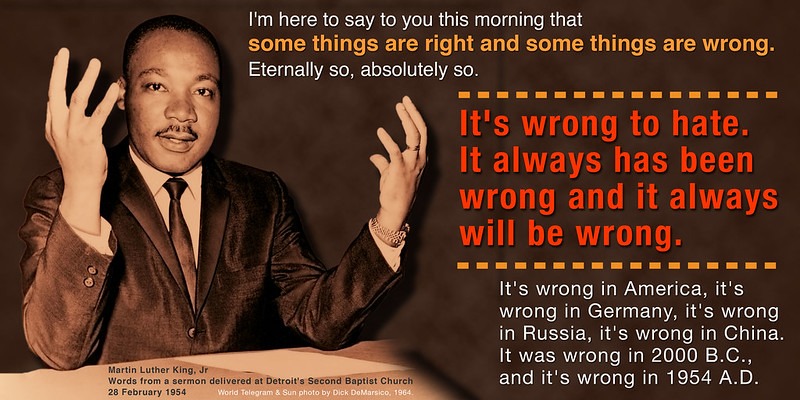
poster with quotes by martin luther king, jr. about hate is wrong
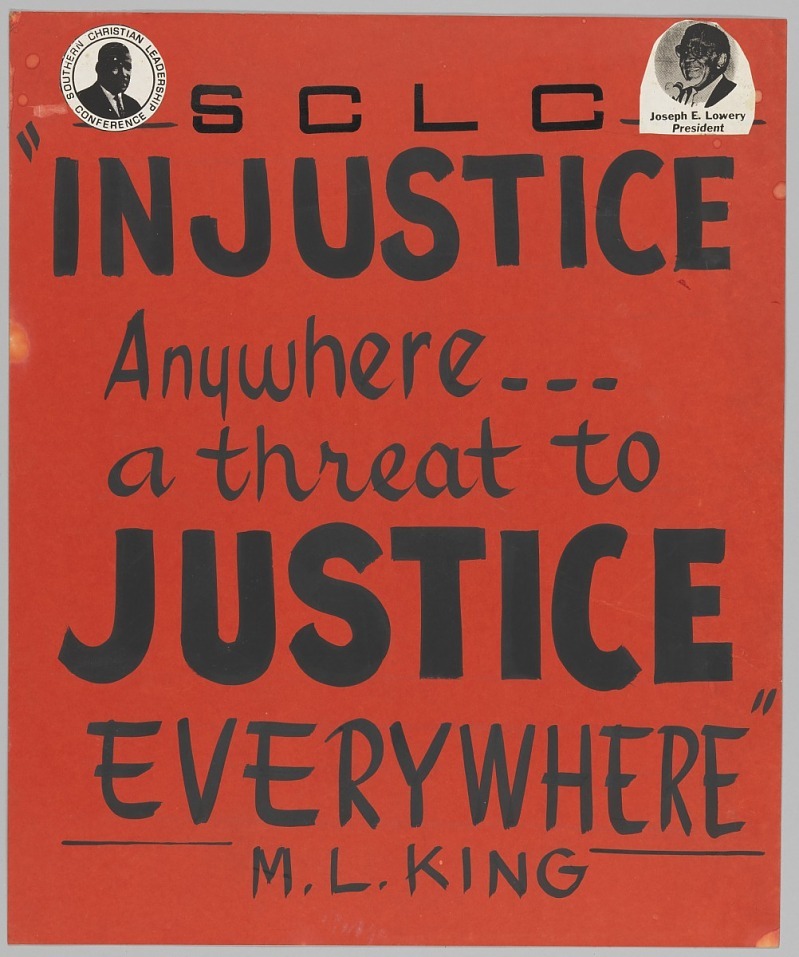
MLK at NCLC Poster "Injustice anywhere is a threat to justice everywhere."


Or, I like this magnetic poster from Displate.com. This is the right idea!

equal rights magnetic poster by displate.com

4. Analyze MLK Primary Sources: What better way to honor Black History than to direct students straight to the sources – the primary sources – the documents written by those who actually experienced the history firsthand, by those who took the time to memorialize their powerful messages in rhetoric that lives on today. 

Here are some of the many primary sources written by, about, or in collaboration with Martin Luther King, Jr.: The March on Washington pamphlet, the I Have a Dream speech (which was delivered 100 years after the Emancipation Proclamation and alluded to Lincoln’s Gettysburg Address), the Letter From Birmingham Jail, Six Principles of Nonviolence (have students write a short explanatory essay explaining what they are and what they mean), MLK’s correspondence with the White House/JFK cabinet in letters and telegrams, teaching about Martin Luther King, Jr., and Memphis Sanitation Workers, Who Speaks for the Negro? collection, I’ve Been to the Mountaintop speech, Senator Robert Kennedy’s Statement on the Assassination of MLK, MLK’s acceptance speech for the Nobel Prize for Peace in 1964, and the Smithsonian collection.

ALSO CHECK OUT THE BLOG POST “MLK in ELA” for EVEN MORE reading, writing, and language ideas!

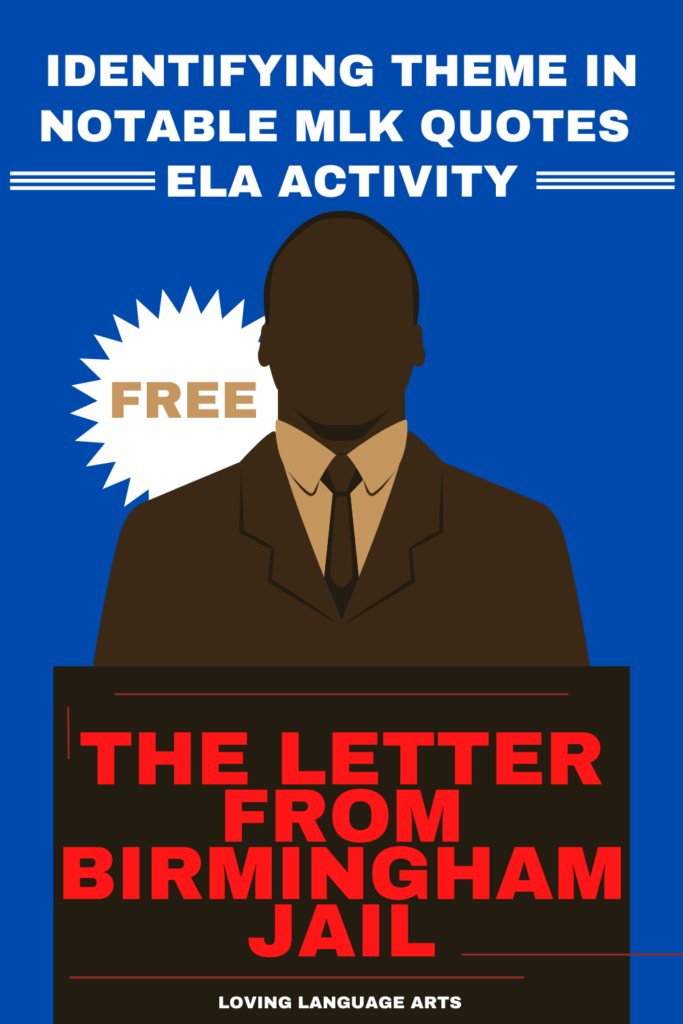
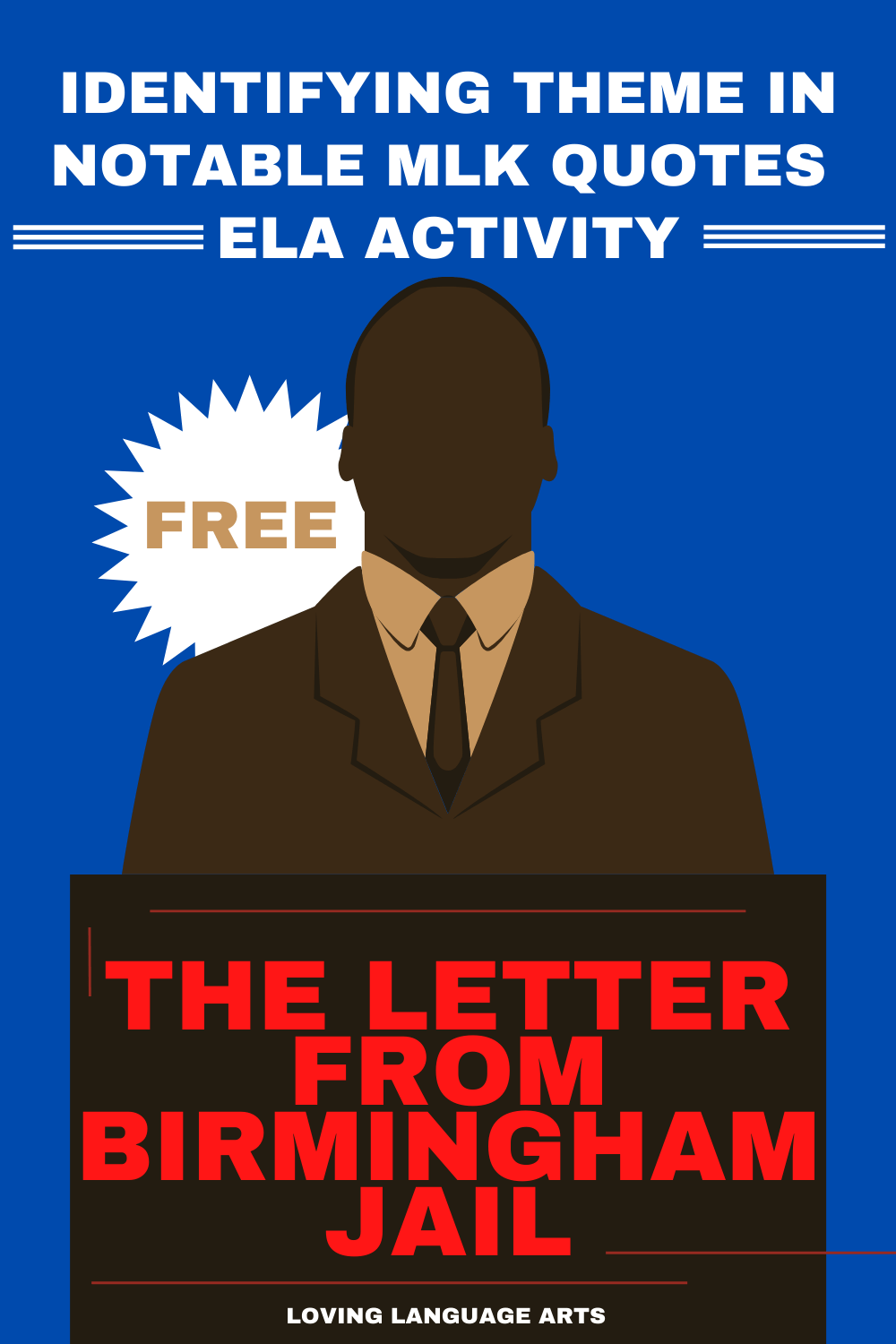
FREE Letter From the Birmingham Jail LESSON: Martin Luther King, Jr.’s Letter From The Birmingham Jail is a must-read. But, what I have for your ELA classroom is a must-have. Grab the FREE PRINTABLE IDENTiFYING THEMES IN NOTABLE MLK QUOTES FROM THE LETTER. It provides students with one page of monumental quotes from the letter, guiding students to identify theme in each of them. This is a standards-based activity, specifically aligned to Standard RI.9 in high school, which is to analyze seminal U.S. documents of literary and historical significance.

YOU CAN PIN THE IMAGE BELOW IF YOU LIKE:

Since teaching ELA for 10 years, I’ve been a contracted learning resource and assessment writer while running my store “Loving Language Arts.” I know how to align to standards like the back of my hand, yet I always aim to make resources high-interest to motivate reluctant readers and writers.

Subscribe

Grade 4 Reading Passages and Practice Tests Workbook - Informational Text Edition
Grade 5 Reading Passages and Practice Tests Workbook - Informational Text Edition
Grade 6 Reading Passages and Practice Tests Workbook - Informational Text Edition
Grade 7 Reading Passages and Practice Tests Workbook - Informational Text Edition
Grade 8 Reading Passages and Practice Tests Workbook - Informational Text Edition
Grade 9 Reading Passages and Practice Tests Workbook - Informational Text Edition
Grade 10 Reading Passages and Practice Tests Workbook - Informational Text Edition
Grade 11 Reading Passages and Practice Tests Workbook - Informational Text Edition
Grade 12 Reading Passages and Practice Tests Workbook - Informational Text Edition
High School Bundle Reading Passages and Practice Tests Workbook - Informational Text Edition
Writing Modules General Promotion Pin

Subscribe

MLK Letter From Birmingham Jail text and task product promotion

NOTE: By the way, my High-Interest Text Passages and Practice Tests Workbooks and my High-Interest Text Passages and ELA Tasks Workbooks contain these speeches and more in easy-print and digital 1-page formats that are MAJOR TIME SAVERS.


5. Learn About “The Green Book”: Have students read this fascinating history about the “Negro Motorist Green Book,” an underground publication sometimes found in gas stations that helped Black citizens travel safely through the Jim Crow-era southern U.S. by directing them to safe places to eat and sleep.

6. Research the Black Lives Matter Movement: One thing I think about all the time is that if people just took the time to understand each other more and where they’re coming from, they’d be less likely to judge them so harshly or condemn their behavior. So, have students take the time to learn about BLM, starting at blacklivesmatter.com. Assign students articles to summarize and share, write a research report, compare and contrast this movement with another, etc.

banner ad new products for middle school ela


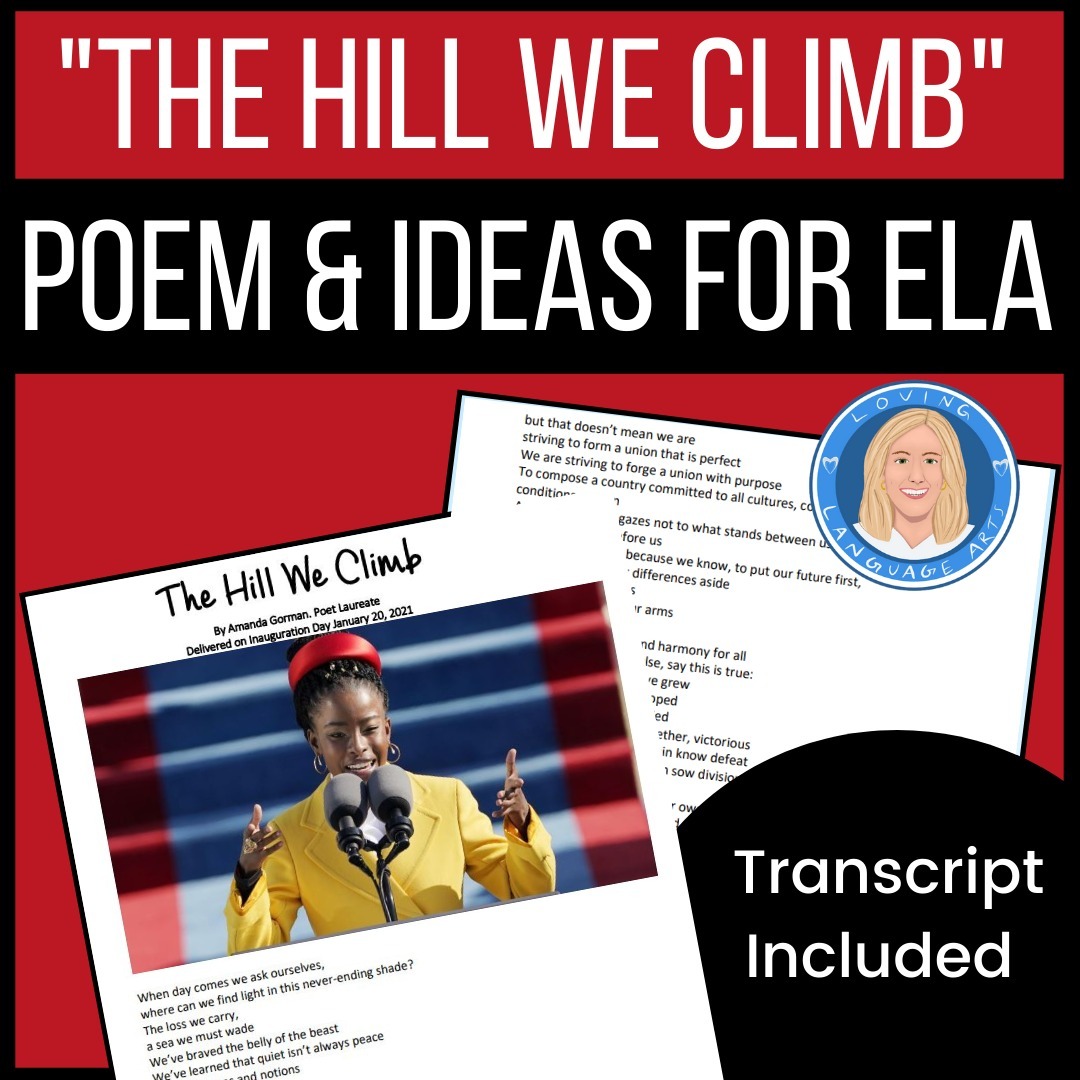
 7. Read Amanda Gorman’s Inaugural Poem “The Hill We Climb” (2021) and the Inaugural Poems That Inspired Her: Amanda Gorman, the youngest (and current) Poet Laureate for the Biden Administration delivered a powerful rendition of her poem “The Hill We Climb,” that resonated not just with black Americans, but all Americans, about the current political climate as a piece in the overall journey for freedom we are all on togther. Check out the free transcript with ELA ideas to use in your classroom today.

Oh, and have your students compare and contrast, or analyze, these five previous inauguration poems that, according to Amanda Gorman, inspired her:

  • Robert Frost, who recited “The Gift Outright” at John F. Kennedy’s 1961 inauguration. Frost recited the poem from memory after he was unable to read the text of the poem, “Dedication,” because of the sun’s glare on the snow-covered ground.
  • Maya Angelou, who read “On the Pulse of Morning” (text; video) at Bill Clinton’s 1993 inauguration
  • Miller Williams, who read “Of History and Hope” (text; video) at Bill Clinton’s 1997 inauguration
  • Elizabeth Alexander, who read “Praise Song for the Day” (text; video) at Barack Obama’s 2009 inauguration
  • Richard Blanco, who read “One Today” (text; video) at Barack Obama’s 2013 inauguration
the hill we climb by amanda gorman 2021 inauguralpoem and activities square cover


8. Combat Racism: Consider having students write persuasive essays and speeches (with reasoning based on evidence, facts, & testimony) that combat racism. Or, I also like the looks of these 6 Lesson Plans We Love for Creating Inclusive Communities and Combatting Racism.

banner ad new products for high school ela


 9. Teach Slave Narratives: Slave narratives are some of the most passionate, eloquent, honest, descriptive pieces of writing you will ever read. I believe it’s a must to have students read at least one. Here are some to consider: Narratives by James Albert Ukawsaw Gronniosaw (1772), Olaudah Equiano (1789), Nat Turner (1831), Frederick Douglass (1845), William Wells Brown (1847), Henry Bibb (1849), Sojourner Truth (1850), William and Ellen Craft (1860), Harriet Jacobs (1861), Jacob Green (1864), and more. Additionally, here is a collection of slave narratives at the Library of Congress (containing more than 2,300 firsthand accounts and over 500 photographs).

Also, GRAB THE FREEBIES below!

free ela passage and test "narrative of william w. brown"
Frederick Douglass Slave Narrative Passage and Task Freebie


10. Teach Students About Brown V. Board of Education and Supreme Court Justice Thurgood Marshall: The Brown v. Board of Education Supreme Court case changed the course of history for the better. It turned out that the “separate but equal” education Black students were getting prior to the case was not so equal. It took declaring segregation as unconstitutional in this landmark case to make everyone see that. There is a plethora of resources on this topic, but here are some: PBS’s “Brown vs. Board of Education | A More or Less Perfect Union” with video, Learning for Justice’s “Brown v. Board: An American Legacy,” and the U.S. Court’s “Justice Thurgood Marshall Profile – Brown v. Board of Education Re-enactment.” 

Or grab the freebie I just added a wee bit late in the month, but better late than never I always say.

Brown v Board of Education Passage & Task Black History Freebie

OK, now at this point I admit I went a little overboard with the Black History Month Freebies. I kept finding all these gems that I wanted to share with you, and here it is the end of February and I am just now stopping, lol. Here are a couple more.

ELA Passage & Test: Word Choice and Rhetoric in Deval Patrick's Inaugural Address
Language & Connotation in Deval Patrick's Inaugural Address Passage and Test

Click below for FREE ELA PRACTICE TESTS – each targeting specific reading, writing, language, and speaking/listening/viewing standards.

Check out these GRADE-SPECIFIC test prep books with practice tests that target EVERY GRADE-SPECIFIC READING INFORMATIONAL TEXT STANDARD, one by one. An added bonus is that students LOVE the texts! In Easy-Print or Self-Grading Online Versions.
Grade 4 Reading Passages and Practice Tests Workbook - Informational Text Edition
Grade 10 Reading Passages and Practice Tests Workbook - Informational Text Edition
Grade 5 Reading Passages and Practice Tests Workbook - Informational Text Edition
Grade 11 Reading Passages and Practice Tests Workbook - Informational Text Edition
Grade 6 Reading Passages and Practice Tests Workbook - Informational Text Edition
Grade 12 Reading Passages and Practice Tests Workbook - Informational Text Edition
Grade 7 Reading Passages and Practice Tests Workbook - Informational Text Edition
we sail for america by samuel mcclure ela practice test

Try a Freebie!

Grade 8 Reading Passages and Practice Tests Workbook - Informational Text Edition
be ready to help passage and ela practice test free

Try a Freebie!

Grade 9 Reading Passages and Practice Tests Workbook - Informational Text Edition
why onions make you cry passage and practice test

Try a Freebie!

The 6th Grade Practice Tests Test Prep Workbook “is a high quality, beautifully-aligned resource. It is no-frills, to the point, yet high-interest for students. It is helping us prepare for standardized testing in a hybrid, synchronous, difficult year.”
ReBeckha L.

Sixth Grade Teacher, Teachers Pay Teachers

How about save this pin to your “Black History Month” Board so that you can come back to this post again?

Black History in ELA blog post pin
teacher talk linky party logo

You are invited to the Inlinkz link party!

Click here to enter

MLK in ELA: Reading & Writing About Martin Luther King, Jr.

MLK in ELA: Reading & Writing About Martin Luther King, Jr.

MLK in ELA: Reading & Writing About Martin Luther King, Jr.

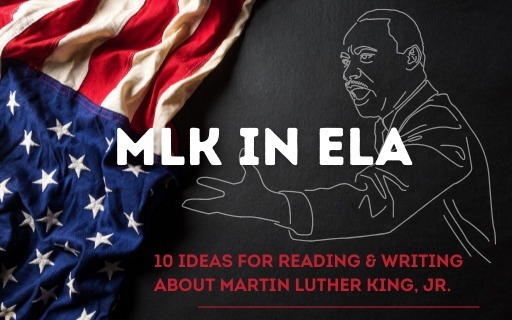
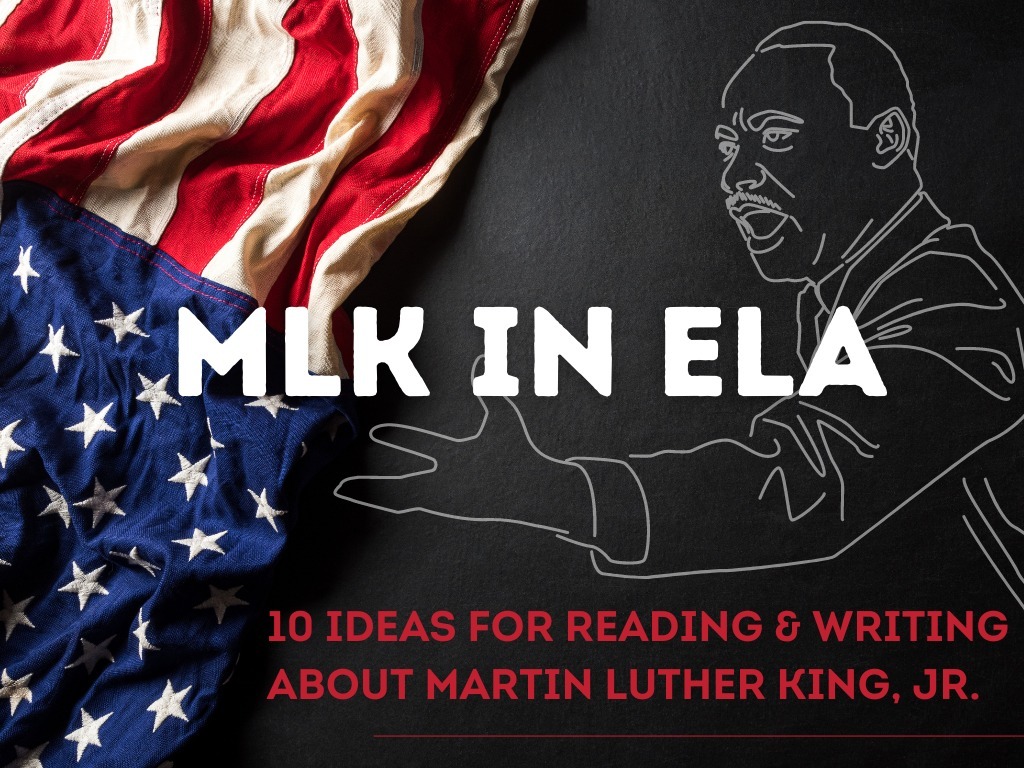
Honoring MLK in ELA really is a no-brainer because there’s a prolific amount of passionate writing you can find that’s been written by, and about, Martin Luther King, Jr.  He was a fantastic speechwriter, a gifted orater, a brave fighter, a true collaborator, a civil rights activist, a tactful communicator — a man passionate and relentless in the ongoing fight for equality. So, here are 10 ideas for reading, writing, and language related to MLK you can incorporate into English language arts any time of year, but especially around MLK Day in January and Black History Month in February. I also give you a free text with ELA task for Letter From Birmingham Jail.

new year in ela blog header

1. Journal Writing on the Topic of MLK: As a bellringer or a 10-minute “quick write” session, have students respond to their choice of journal topic. Here are a BUNCH of ideas: What do you know about MLK? Why do you think some states used to refuse to designate MLK Day a holiday while other states consistently pushed for it to be a holiday? MLK had a dream of equality; what do you sometimes dream about that would make the world a better place? Can you think of any ways to work on making your dream come true someday? Since MLK was assassinated in 1968 , in your opinion, how has the fight for equality continued in America (including ups and downs and signs of progress)? Who has taken the place of, or has continued in the footsteps of, MLK since he was killed? What do MLK and Black Lives Matter have to do with each other (broadly speaking)? What makes Martin Luther King, Jr. so memorable?

2) Looking at the “I Have a Dream” Speech as Literature: When we look at works of nonfiction as literature, we call that Reading Literary Nonfiction. The “I Have a Dream” speech uses literary devices and techniques in such as way so as to move the reader, so that’s literary nonfiction. Not only that, but it’s an amazing speech with such a powerful message. Now I was going to make a whole little lesson right here, but I actually found a GREAT lesson plan for teaching the speech at the PBS Newshour website. So, rather than reinvent the wheel, you should check it out! But then promise to come back, ok?

banner ad upper elementary ela resources

3. Explain How You Would Improve the World (Dare to Dream): Most likely your students have spent some time daydreaming how they would make the world a better place. Heck, they might even be daydreaming right now with all this talk of the “I Have a Dream” speech. So, tap into the passion! Have students choose one aspect of the way things are in the world that they want to change.  And, here’s the explanatory writing part — have them explain it in detail, including three specific steps they would take in the process to fulfill the dream. Have them include an introduction and conclusion — and BAM! — another standards-based essay done in no time.

4. Letter From the Birmingham Jail: Martin Luther King, Jr.’s Letter From The Birmingham Jail is a must-read. But, what I have for your ELA classroom is a must-have. Grab the FREE PRINTABLE IDENTiFYING THEMES IN NOTABLE MLK QUOTES FROM THE LETTER. It provides students with one page of monumental quotes from the letter, guiding students to identify theme in each of them. This is a standards-based activity, specifically aligned to Standard RI.9 in high school, which is to analyze seminal U.S. documents of literary and historical significance.

YOU CAN PIN THE IMAGE BELOW IF YOU LIKE:

MLK Letter From Birmingham Jail text and task product promotion


5. Explain the Six Principles of Nonviolence: Have students read King’s Six Principles of Nonviolence and write a short explanatory essay explaining what they are and what they mean. Exploring nonviolence seems like a good use of time in my opinion. Speaking of opinions, have your students write an opinion or persuasive essay about the six principles.

6. Compare and Contrast Influential Speeches: When you read enough of the monumental speeches made during American history, you start to notice similarities and differences in their structure, language/use of rhetoric, and repeated allusions to the ideals of freedom set forth in the Constitution. So, this is good news for ELA! You can have students compare and contrast speeches, honing in on such things as figurative language, rhetoric, structure, allusions, tone and attitude, being direct vs. being metaphorical, being tactful vs. aggressive, etc. Here are some ideas: Lincoln’s Gettysburg Address, JFK’s Inaugural Address, Deval Patrick’s Inaugural Address, Obama’s speeches such as his 2008 acceptance speech (the yes we can/si se puede speech) or the 2009 Inaugural Address (and many more), etc.

NOTE: By the way, my High-Interest Text Passages and Practice Tests Workbooks and my High-Interest Text Passages and ELA Tasks Workbooks contain these speeches and more in easy-print and digital 1-page formats that are MAJOR TIME SAVERS.

banner ad new products for middle school ela

7. Read the Nobel Peace Prize Acceptance Speech: When Martin Luther King, Jr. accepted the Nobel Prize for Peace in 1964, he delivered an amazing acceptance speech. Have students explain what the award is a “profound recognition” of. In the speech, he stated, “Sooner or later all the people of the world will have to discover a way to live together in peace…” In order for that to happen, what method must people learn, according to MLK?

8. Get Artistic About MLK.: How about assign each student a different quote by MLK (here is a list of 25 Quotations by MLK for the Classroom), and then have them do an artistic representation of it on an 8 12″ x 11″ page? Have them make the quotation visible, write 5 adjectives on the page describing it, include 5 images, etc….you decide.

banner ad new products for high school ela

9. Read Robert F. Kennedy’s Statement on the Assassination of Martin Luther King, Jr.: Sadly, this man who was making so much traction on the platform of nonviolence, was killed in 1968. Senator Robert F. Kennedy made a lovely statement to comfort others and remind them of his cause: “What we need in the United States is not division; what we need in the United States is not hatred; what we need in the United States is not violence or lawlessness; but love and wisdom, and compassion toward one another, and a feeling of justice toward those who still suffer within our country, whether they be white or they be black.” Have students write about their opinion on all of this, including examples.

10. MLK Biography Block: Have students read a biography of MLK and then, instead of those boring book reports that put everyone to sleep, have your students make biography blocks instead. Grab the FREE Biography Block Lesson and Template. And check out the sample Clara Barton biography block below.

Since teaching ELA for 10 years, I’ve been a contracted learning resource and assessment writer while running my store “Loving Language Arts.” I know how to align to standards like the back of my hand, yet I always aim to make resources high-interest to motivate reluctant readers and writers.

Subscribe

Grade 4 Reading Passages and Practice Tests Workbook - Informational Text Edition
Grade 5 Reading Passages and Practice Tests Workbook - Informational Text Edition
Grade 6 Reading Passages and Practice Tests Workbook - Informational Text Edition
Grade 7 Reading Passages and Practice Tests Workbook - Informational Text Edition
Grade 8 Reading Passages and Practice Tests Workbook - Informational Text Edition
Grade 9 Reading Passages and Practice Tests Workbook - Informational Text Edition
Grade 10 Reading Passages and Practice Tests Workbook - Informational Text Edition
Grade 11 Reading Passages and Practice Tests Workbook - Informational Text Edition
Grade 12 Reading Passages and Practice Tests Workbook - Informational Text Edition
High School Bundle Reading Passages and Practice Tests Workbook - Informational Text Edition
Writing Modules General Promotion Pin

Subscribe

Click below for FREE ELA PRACTICE TESTS – each targeting specific reading, writing, language, and speaking/listening/viewing standards.

Check out these GRADE-SPECIFIC test prep books with practice tests that target EVERY GRADE-SPECIFIC READING INFORMATIONAL TEXT STANDARD, one by one. An added bonus is that students LOVE the texts! In Easy-Print or Self-Grading Online Versions.
Grade 4 Reading Passages and Practice Tests Workbook - Informational Text Edition
Grade 10 Reading Passages and Practice Tests Workbook - Informational Text Edition
Grade 5 Reading Passages and Practice Tests Workbook - Informational Text Edition
Grade 11 Reading Passages and Practice Tests Workbook - Informational Text Edition
Grade 6 Reading Passages and Practice Tests Workbook - Informational Text Edition
Grade 12 Reading Passages and Practice Tests Workbook - Informational Text Edition
Grade 7 Reading Passages and Practice Tests Workbook - Informational Text Edition
we sail for america by samuel mcclure ela practice test

Try a Freebie!

Grade 8 Reading Passages and Practice Tests Workbook - Informational Text Edition
be ready to help passage and ela practice test free

Try a Freebie!

Grade 9 Reading Passages and Practice Tests Workbook - Informational Text Edition
why onions make you cry passage and practice test

Try a Freebie!

The 6th Grade Practice Tests Test Prep Workbook “is a high quality, beautifully-aligned resource. It is no-frills, to the point, yet high-interest for students. It is helping us prepare for standardized testing in a hybrid, synchronous, difficult year.”
ReBeckha L.

Sixth Grade Teacher, Teachers Pay Teachers

How about save this pin to your “Seasonal Resources,” “Diversity in ELA,” or “Literary Nonfiction” Board so that you can come back to this post again?
Pin MLK free text and task birmingham jail
teacher talk linky party logo

You are invited to the Inlinkz link party!

Click here to enter