
Patriot Day in ELA
As an English language arts teacher, you are in a unique position to help students process and understand why we observe Patriot Day and what happened on September 11, 2011 by having them: read informational texts, read first-hand accounts, poetry, fiction, and more; write in a variety of genres (critical thinking); explore the difference between accurate, reliable sources/accounts and garbage (stereotypes, false claims, sensationalism); explore themes such as courage and resilience; and, analyze language such as rhetoric and vocabulary. That’s what I love about ELA! We are here to guide critical thinking, not just lay facts on them. I believe critical thinking might be the most important thing we can facilitate in our classrooms today. Help students discover accurate historical context without overwhelming them with graphic details or images. Focus on remembrance, community, and the facts.

1. Write a cause-and-effect essay: The fact of the matter is that September 11, 2001 became a catalyst for changes: creation of Homeland Security, increased surveillance (cameras, facial recognition, access to “private” cell phone data, etc.), changes to privacy rights, creation of the TSA in airports (Transportation Security Administration), broken families, loss of loved ones, shaking up our sense of stability and security, and more. Have students give some factual background on some aspect of the 9/11 terrorist attacks (the cause), and use transition words/phrases to explain what changed as a result, and how (the effect). You should have students evaluate sources for accuracy and credibility, and then cite them as text evidence.
2. Write an explanatory essay: I was actually teaching middle school ELA on 9/11/01, and I was at a loss for words of how to quickly, accurately, and objectively explain what was happening. It would have been helpful to have a premade paragraph. Have students imagine they have children their age and have to explain it to them. Just the facts! No emotions, no stereotypes, no sweeping generalizations, no racism, no misinformation. What happened – who, what, where, when, how, why? Just have them explain the facts.

3. Jigsaw groups to explore 9/11 poetry: Direct students to https://www.poetryfoundation.org/categories/september-11th?sectionHandle=poems and assign different poems to students. Have students sit in small groups. Each student reads their selected poem. They have a short discussion about what it means, its symbolism, etc. before moving on to the next one.

4. Explore Impactful Vocabulary: Have students make a simple bubble map with a circle in the middle and four bubbles attached with prongs. In the circle in the middle, have students write the vocabulary word, and its definition. In the four bubbles, have students write examples of ways people showed or show this quality in regards to September 11th or Patriot Day. Here are some ideas for words: courage, resilience, remembrance, regrowth, security, recovery.
5. Compare and contrast primary source first-hand accounts: Direct students to this credible website which features vetted firsthand accounts of September 11, 2001 at or near Ground Zero: https://911groundzero.com/firsthand-accounts/. The collection is called “We are New Yorkers with personal connections to the events of September 11, 2001.” Have students select two of the firsthand accounts, and write a compare-and-contrast essay about the similarities and differences between their experiences, or even the tone/attitude and language they use. Students should quote text evidence, and explain it.

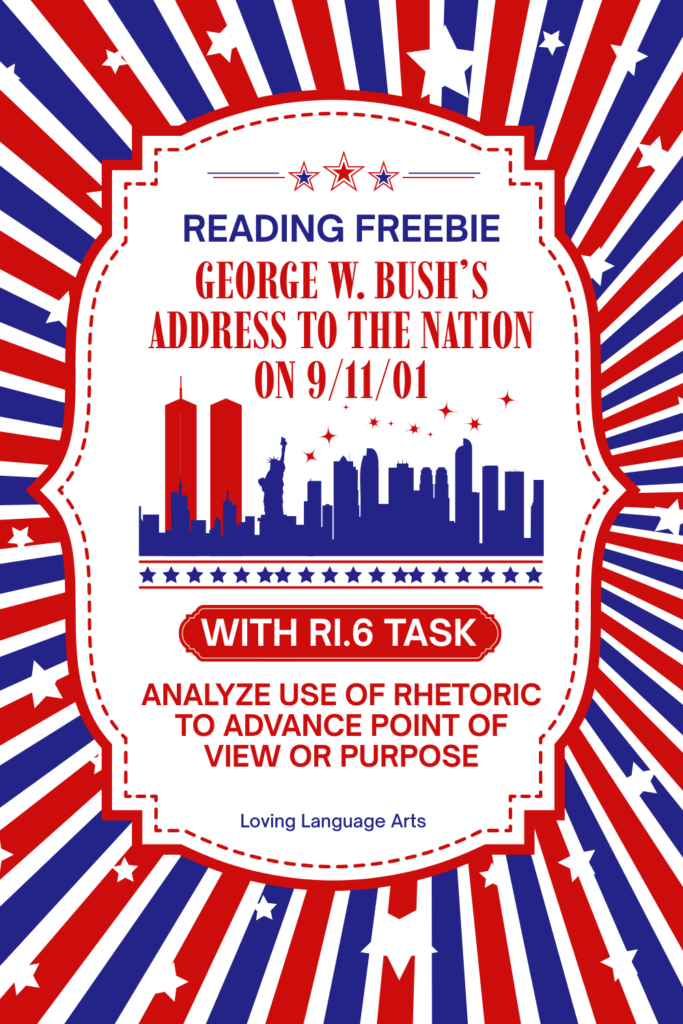
6. Use this Reading Freebie: I created what I think is an awesome reading freebie: Analyzing Rhetoric to Advance Purpose or Point of View in President George W. Bush’s Address to the Nation on 9/11/01. FREE Reading an Informational Text with an ELA Task aligned to RI.6 (Analyze rhetoric to advance purpose or point of view): I like that it is short and sweet; the speech is only ONE PAGE and the task is only ONE PAGE, making it easy to print if desired. There is also an interactive Google Slides version as well. This lesson is included in the Reading Informational Text Workbook for Grade 10, but it can be used in various grades.
It has students analyze use of:
- figurative language
- allusion to and quote from the Bible
- anaphora
- antithesis
- tone
- appeals to audience
- claims and whether they are credible
- other rhetorical devices such as descriptive adjectives and metaphors
- point of view
- author’s purpose
It is aligned to these standards:
- RI.9-10.6 (Determine an author’s point of view or purpose in a text and analyze how an author uses rhetoric to advance that point of view or purpose.)
- RI.6 for grades 6, 7, 8, 9, 10, 11, 12 (Assess how point of view or purpose shapes the content and style of a text.)
- RI.9-10.9 Analyze seminal U.S. documents of historical and literary significance (e.g., Washington’s Farewell Address, the Gettysburg Address, Roosevelt’s Four Freedoms speech, King’s “Letter from Birmingham Jail”), including how they address related themes and concepts.
- RI.9-10.8 (Delineate and evaluate the argument and specific claims in a text, assessing whether the reasoning is valid and the evidence is relevant and sufficient; identify false statements and fallacious reasoning.)
- RI.8 for all grades (Delineate and evaluate the argument and specific claims in a text, including the validity of the reasoning as well as the relevance and sufficiency of the evidence.
- RI.1 for all grades (Read closely to determine what the text says explicitly and to make logical inferences from it; cite specific textual evidence when writing or speaking to support conclusions drawn from the text.)
- L.5 for all grades (Demonstrate understanding of figurative language, word relationships, and nuances in word meanings.)
Please save this pin to your Pinterest boards, so you can access it easier, year after year:
Check out these GRADE-SPECIFIC workbooks with ELA tasks or practice tests that target EVERY GRADE-SPECIFIC READING LITERATURE TEXT STANDARD, one by one. An added bonus is that students LOVE the texts! In Easy-Print or Self-Grading Online Versions.


“My students absolutely LOVE these! They were asking for more! Thank you!”

How about save this pin to your Pinterest boards so that you can come back to this post again?




0 Comments