10 Great Ways for Students to Research and Present Information

10 Great Ways for Students to Research and Present Information

10 Great Ways for Students to Research and Present Information

This year, when you are looking for ideas that go beyond the boring book report or essay, but you still want students to read informational text and present what they learned, try one of these ten ideas. Trust me, they will be happy with the creative approaches and you’ll be happy when it’s time for them to present them to you and the class, and when it comes time for you to grade them all.

1. A Biography Block (or Block for Any Info)

When I had 90 students research and present biographies, the last thing my students and I wanted to do was listen to lengthy presentations or read lengthy reports. But, by having them make these biography blocks, it resulted in shorter, to-the-point presentations as well as awesome visual displays that could be left all around the room for students to look at. In my free lesson, you will get the template and directions for an easy no-prep lesson. Now, you can also use the block to have students present any other kind of information. When placed around the classroom, students pick them up to admire them and they end up learning something at the same time! Win-win. (& making it = storing memories). Get my FREE lesson that comes with directions and a block template. 

banner ad upper elementary ela resources

2. Brochures for book reports, biographies, destinations, and lots of other things. 

There are a lot of people offering free as well as paid brochure templates with great ideas for how to use them. A couple that I liked were a free book report brochure by TPT seller Student Savvy , and a free travel brochure by Literacy in Focus below. They show you how to turn book reports or other English assignments into brochure form instead, which is so much more fun & readable!

editable novel brochure template
travel brochure template for book report or presentation of information

3. Pyramids 

Similar to the blocks in #1, the pyramid is a visual display that other students can pick up, admire, and learn something quickly  in the process. (Plus, the act of making it gets the info in the student’s brain.) These are a couple examples that go with free WebQuests I made. The WebQuest is the research part and the pyramid is one part of the presenting part. The pyramid template comes FREE with the lesson.

1) Researching a Dog Breed’s Character Traits and History FREE WebQuest: In this free lesson, students are guided step-by-step (so no prep) tor research dog breeds and input information into a premade Google sheet. Then, they can choose one breed of their choice to present.

2) Researching “Why Do We Need Vitamins and Minerals Anyway?” FREE WebQuest: Students are always hearing about getting proper nutrition but most have no clue even what vitamins and minerals do. This helps them find out. Then, they can each select a different nutrient and present it on a pyramid. That way there are a variety of pyramids around the room teaching everyone about different nutrients.

4. Wax Museum: They do this at my kids’ school every year and it is a huge hit that draws crowds. Students do a biography report with a visual display, then on presentation day, they stand there as if they are wax figures. One option is for people to pay a penny, or quarter, or any amount (as a fundraiser) to get them to talk. They are dressed up like the people, talk like the people, talk about themselves. What a great idea. There is even an option to have it run through an entire school day and have the younger grade students rotate through. All the kids love it! Here is my daughter dressed as John McCain and her friend was Wayne Gretzky (in this modern age of defying gender stereotypes):

banner ad new products for middle school ela
5. PowerPoint Presentation or Google Slides: Am I right that we need to train our youth to give good presentations so they don’t bore the heck out of their colleagues in future jobs?! It occurred to me that a presentation would be a good way to present the information about the dog breed from example 3 above. I would have students do these slides: 1) introduce the breed with a picture and give some numbers about its height, weight, lifespan, and point out some physical characteristics, 2) Along with another picture, summarize the dog’s temperament and give around 5 character trait words that describe it, 3) Give 5 interesting facts about its history, 4) Other interesting facts. This would go quite well with my FREE Dog Traits and History WebQuest. By the way, I found over 300 character trait words on one website in the WebQuest. Wow! I think this activity would also work well to explain how something works.
 
Here is an example of page 1 of a presentation on Pitbulls that would work with the free lesson:

6. Poster (a.k.a. Infographic): Again, keep in mind that just the act of making something with your hands and writing stores the information in your mind long-term and attaches good feelings to it. So, although it might seem like a waste of time and you might wonder what the point is if it is something you are going to throw away, just remember this, as research has proven. Think back to the memories you have of school assignments. The ones you still remember (including the basic information) are the ones you made by hand! Here’s a couple that students can create after learning “The Science Behind Ice Cream” in my FREE ELA or Literacy in Science informational text and tasks:

And this one goes well with my FREE “Why There Are Seasons” informational text & tasks for ELA or Literacy in Science:

7. Interview: This could literally be done or figuratively be done…what I mean is that students could conduct a real interview with someone (in person, by email, by video, by voice recording, so many options) or they could do a fake interview with an actor (brother, mother, friend, so many options). The point is that the questions should be thoughtful and the answers should yield good information. In any case, it should be scripted beforehand (you know, like on “reality” TV lol).
8. Digital Poster (a.k.a. Infographic): In a distance learning situation or when you want students to have the digital option, a digital poster can do the trick. This allows for easy usage of photographs and diagrams that don’t have to be printed, something that is key if there are a lot of graphics. For example, this one is about a popular research topic, the Titanic (man I loved that movie lol). My daughter made it in Google Slides on an 18×12 slide. I remember having students doing this at school by hand, making black and white copies with the copy machine, but this was much more efficient.

9. Collage: Who doesn’t like collages? Nobody. Which kids don’t know how to make a collage? Hardly any. These can be done physically or digitally and are a great way to show a lot of visuals at once. For example, these look intriguing (the one about Lincoln is an Etsy item, but could be done by a student):

10. Video: If this sounds scary, have no fear. Kids are making quick videos about everything these days, so just ask them for ideas. Again, a good option for distance learning.

banner ad new products for high school ela

Since teaching ELA for 10 years, I’ve been a contracted learning resource and assessment writer while running my store “Loving Language Arts.” I know how to align to standards like the back of my hand, yet I always aim to make resources high-interest to motivate reluctant readers and writers.

Subscribe

Grade 4 Reading Passages and Practice Tests Workbook - Informational Text Edition
Grade 5 Reading Passages and Practice Tests Workbook - Informational Text Edition
Grade 6 Reading Passages and Practice Tests Workbook - Informational Text Edition
Grade 7 Reading Passages and Practice Tests Workbook - Informational Text Edition
Grade 8 Reading Passages and Practice Tests Workbook - Informational Text Edition
Grade 9 Reading Passages and Practice Tests Workbook - Informational Text Edition
Grade 10 Reading Passages and Practice Tests Workbook - Informational Text Edition
Grade 11 Reading Passages and Practice Tests Workbook - Informational Text Edition
Grade 12 Reading Passages and Practice Tests Workbook - Informational Text Edition
High School Bundle Reading Passages and Practice Tests Workbook - Informational Text Edition
Writing Modules General Promotion Pin

Subscribe

You Know What Else Kids Love?

These workbooks! I made the articles super interesting to kids by writing about things that interest them! AND IT WORKED! I keep hearing from teachers how kids get so into these texts that they actually WANT to answer the questions!
Click below for FREE ELA PRACTICE TESTS – each targeting specific reading, writing, language, and speaking/listening/viewing standards.

Check out these GRADE-SPECIFIC test prep books with practice tests that target EVERY GRADE-SPECIFIC READING INFORMATIONAL TEXT STANDARD, one by one. An added bonus is that students LOVE the texts! In Easy-Print or Self-Grading Online Versions.
Grade 4 Reading Passages and Practice Tests Workbook - Informational Text Edition
Grade 10 Reading Passages and Practice Tests Workbook - Informational Text Edition
Grade 5 Reading Passages and Practice Tests Workbook - Informational Text Edition
Grade 11 Reading Passages and Practice Tests Workbook - Informational Text Edition
Grade 6 Reading Passages and Practice Tests Workbook - Informational Text Edition
Grade 12 Reading Passages and Practice Tests Workbook - Informational Text Edition
Grade 7 Reading Passages and Practice Tests Workbook - Informational Text Edition
we sail for america by samuel mcclure ela practice test

Try a Freebie!

Grade 8 Reading Passages and Practice Tests Workbook - Informational Text Edition
be ready to help passage and ela practice test free

Try a Freebie!

Grade 9 Reading Passages and Practice Tests Workbook - Informational Text Edition
why onions make you cry passage and practice test

Try a Freebie!

The 6th Grade Practice Tests Test Prep Workbook “is a high quality, beautifully-aligned resource. It is no-frills, to the point, yet high-interest for students. It is helping us prepare for standardized testing in a hybrid, synchronous, difficult year.”

ReBeckha L.

Sixth Grade Teacher, Teachers Pay Teachers

How about save this pin to your “Researching and Presenting” or “Presentations in ELA” Board so that you can come back to this post again?

blog post 10 ways to research and present information in ela

How Chameleons Change Colors: An ELA Literacy in Science Lesson

How Chameleons Change Colors: An ELA Literacy in Science Lesson

How Chameleons Change Colors: An ELA Literacy in Science Lesson

This fun lesson combines science and ELA (a.k.a. literacy in science). Students read about why and how chameleons change color. They explain why chameleons change color in their own words. They make their own paper chameleons change colors in a mini science experiment. They read more informational text about acids, bases, and chemical reactions. Finally, they explain what caused their chameleons to change color (has to do with acids, bases, & chemical reactions).


Follow These Easy Steps:

(optional) Read a short story to students about chameleons. I happened to have one on hand called The Chameleon Who Couldn’t Make Up His Mind. Or I found this short read aloud of a similar story The Chameleon Who Couldn’t Change Colour.

Give students an overview of the lesson (you can read the first paragraph at the top). Get them excited about the hands-on mini science experiment and then they will be more motivated to do the reading and writing that comes first.

Real quick, either you show them or have them look themselves at a cool animation of a color-changing chameleon at nationalgeographic.com. (This part only needs to last 10 seconds.)

Next, students read the article Why Do Chameleons Change Their Colors? Tell them ahead of time to keep their eyes peeled specifically for the section on WHY (not how) they change colors. (Btw that section starts with “So why would they want to change colors?”)

Either give students the paragraph writing sheet that is provided at the end of this post or have them write on their own piece of paper. They will write a paragraph to explain why chameleons change colors. This essentially involves writing a summary of the two paragraphs that start with “So why would they want to change colors?”

Next is the science experiment. Students will be dipping q-tips into three liquids and “painting” them on to a chameleon outline.

  • Decide if you want to have students share supplies at tables or if you will rotate them through a station, etc.
  • Each student needs access to a small cup of grape juice, a small cup of vinegar, and a small cup of water that has been mixed with 2 tablespoons of baking soda. Each student needs 3 cotton swabs.
  • Hand out chameleon pattern sheets (provided below) to each student. They need to set these sheets on top of a paper towel because the liquids will bleed through the paper. Also, grape juice can stain, and though it is unlikely it will get on students, you may want them to wear smocks.
  • Here is the procedure: dip the cotton swab in the grape juice (which is slightly acidic) and “paint” the chameleon. Allow the chameleon to dry for about 5 minutes. Student may need to gently wave it in the air or put it outside to ensure it dries enough.
  • Now, students can view a chemical reaction by dipping another q-tip into the baking soda mixture and then dabbing it onto the chameleon. They can make spots or stripes. These areas will turn a bluish-green. A color change indicates a chemical reaction has taken place between an acid and a base.
  • To see what happens when they add a chemical that is highly acidic, students use a different cotton swab to dip into the vinegar and then dab that on to see that it turns pink.

Finally, students will read the paragraph about chemical reactions that is below the chameleon pattern. This explains why their chameleons changed color if they read it analytically. Have students write the paragraph about what caused their chameleons to change color.


8th Grade Student Example

banner ad new products for high school ela

7th Grade Student Example


4th Grade Student Example

 banner ad new products for middle school ela

Template: Paragraph Response Sheet


banner ad upper elementary ela resources
chameleons and chemical reactions template for experiment and reading

Template: Chameleon Outline & Informational Text

chameleons and chemical reactions template for experiment and reading

Since teaching ELA for 10 years, I’ve been a contracted learning resource and assessment writer while running my store “Loving Language Arts.” I know how to align to standards like the back of my hand, yet I always aim to make resources high-interest to motivate reluctant readers and writers.

Subscribe

Grade 4 Reading Passages and Practice Tests Workbook - Informational Text Edition
Grade 5 Reading Passages and Practice Tests Workbook - Informational Text Edition
Grade 6 Reading Passages and Practice Tests Workbook - Informational Text Edition
Grade 7 Reading Passages and Practice Tests Workbook - Informational Text Edition
Grade 8 Reading Passages and Practice Tests Workbook - Informational Text Edition
Grade 9 Reading Passages and Practice Tests Workbook - Informational Text Edition
Grade 10 Reading Passages and Practice Tests Workbook - Informational Text Edition
Grade 11 Reading Passages and Practice Tests Workbook - Informational Text Edition
Grade 12 Reading Passages and Practice Tests Workbook - Informational Text Edition
High School Bundle Reading Passages and Practice Tests Workbook - Informational Text Edition
Writing Modules General Promotion Pin

Subscribe

You Know What Else Kids Love?

These workbooks! I made the articles super interesting to kids by writing about things that interest them! AND IT WORKED! I keep hearing from teachers how kids get so into these texts that they actually WANT to answer the questions!
Click below for FREE ELA PRACTICE TESTS – each targeting specific reading, writing, language, and speaking/listening/viewing standards.

Check out these GRADE-SPECIFIC test prep books with practice tests that target EVERY GRADE-SPECIFIC READING INFORMATIONAL TEXT STANDARD, one by one. An added bonus is that students LOVE the texts! In Easy-Print or Self-Grading Online Versions.
Grade 4 Reading Passages and Practice Tests Workbook - Informational Text Edition
Grade 10 Reading Passages and Practice Tests Workbook - Informational Text Edition
Grade 5 Reading Passages and Practice Tests Workbook - Informational Text Edition
Grade 11 Reading Passages and Practice Tests Workbook - Informational Text Edition
Grade 6 Reading Passages and Practice Tests Workbook - Informational Text Edition
Grade 12 Reading Passages and Practice Tests Workbook - Informational Text Edition
Grade 7 Reading Passages and Practice Tests Workbook - Informational Text Edition
we sail for america by samuel mcclure ela practice test

Try a Freebie!

Grade 8 Reading Passages and Practice Tests Workbook - Informational Text Edition
be ready to help passage and ela practice test free

Try a Freebie!

Grade 9 Reading Passages and Practice Tests Workbook - Informational Text Edition
why onions make you cry passage and practice test

Try a Freebie!

The 6th Grade Practice Tests Test Prep Workbook “is a high quality, beautifully-aligned resource. It is no-frills, to the point, yet high-interest for students. It is helping us prepare for standardized testing in a hybrid, synchronous, difficult year.”

ReBeckha L.

Sixth Grade Teacher, Teachers Pay Teachers

How about save this pin to your “Literacy in Science” or “Science in ELA” Pinterest Board so that you can come back to this post again?

color changing chameleons science activity for ELA reading and writing pin

My Rule #1 for Teaching Middle School

My Rule #1 for Teaching Middle School

My Rule #1 for Teaching Middle School

Teaching middle school is like no other teaching assignment – like no other task on Earth for that matter. As a teacher, you need to be just the right mix of cool and strict – but most important, calm. You need to have a good relationship with your students overall based on mutual respect. But that’s much easier said than done.

blog post rule #1 for teaching middle school


Here’s the thing about middle schoolers in particular:

They want to look good in front of their peers. What their peers think of them is of utmost importance to them (whether they are in touch with that reality or not).  

Therefore, they will “save face” if they think you, the teacher, are criticizing them or making them look bad in any way. (Meanwhile, you meant no harm; you were simply calling them out on a behavior they clearly exhibited).

The thing is you can’t call them out in front of their peers. I mean you can, but you shouldn’t. Whenever possible, call out their less-than-stellar behavior one-on-one, without their peers hearing it. This could mean going to their desk and whispering, or waiting for a good time to call them to your desk ever so calmly. It’s easier to call them out from wherever you are, but if you want your class under control and to maintain respect, somehow arrange a private convo instead. 

The Goal is this, which is my #1 Rule for Teaching Middle School: No Power Struggles


middle school class of students

Have you ever noticed how some kids act so differently when their peers aren’t around? Let’s say a kid in your class before lunch was really pushing your buttons and disrupting class, but then he forgets his lunch in your room. He comes back to get it. You two talk. He’s really nice and respectful! You have a pleasant conversation. You’re wondering if this is the same person or perhaps a twin brother you weren’t aware of. What is going on? IT’S BECAUSE HIS PEERS AREN’T THERE!  I’m using a boy as an example, but the same thing applies to girls.

symbol of no power struggles

Do NOT try to address a student’s behavior in full view of his or her peers (a.k.a. the audience). You could get yourself into a full-blown power struggle before you know it. At first, by drawing attention to his or her behavior in front of his or her peers, you may inadvertently say something or suggest something that makes the student, from his or her perspective, look bad or uncool or different in some way.

If you’re not careful, you might find that the child you’re disciplining escalates the situation, essentially trying to look good at any cost, even if that means receiving a negative consequence. For some kids, receiving a negative consequence is just more attention (and even negative attention is attention) and the whole situation will most likely make most of the students in the class think you’re the bad guy and he or she is the good guy. You don’t want that. There should not be a bad guy or a good guy, just you the teacher calmly in control.

no power struggles with big word no

Here’s another trick I learned. When you provide your students with high-interest learning resources they feel are relevant to them and interesting in some way, they will actually behave better. They will get sucked into whatever you are trying to get them read, write, or do and forget about misbehaving.

So, that’s why I created these high-interest informational texts and tasks. I went out of my way to make the articles super interesting to middle schoolers by writing about things that interest them. And, guess what? It worked. I keep hearing from teachers how kids get so into these passages. They actually want to answer the questions. They even want to discuss the articles as a group. 

middle school informational text passages and ela tasks volume 1

And teachers keep reporting how much time and hassle I have saved them. I did that by aligning every text and task to a specific Reading Informational Text Standard and did that 10 times to cover all 10 of them individually. Now teachers don’t have to go searching for the right articles that bring out the right skills.

Try both volumes and use them all year long! Your students are actually going to behave better because they won’t be bored!

middle school informational text passages and ela tasks volume 2

I even made them in both PDF and interactive Google Slides in case you want the easy distance learning option!

banner ad new products for middle school ela
save yourself hours of internet searches promo
GIF showing kids who hate textbooks but love using Loving Language Arts resources

Since teaching ELA for 10 years, I’ve been a contracted learning resource and assessment writer while running my store “Loving Language Arts.” I know how to align to standards like the back of my hand, yet I always aim to make resources high-interest to motivate reluctant readers and writers.

Subscribe

Grade 4 Reading Passages and Practice Tests Workbook - Informational Text Edition
Grade 5 Reading Passages and Practice Tests Workbook - Informational Text Edition
Grade 6 Reading Passages and Practice Tests Workbook - Informational Text Edition
Grade 7 Reading Passages and Practice Tests Workbook - Informational Text Edition
Grade 8 Reading Passages and Practice Tests Workbook - Informational Text Edition
Grade 9 Reading Passages and Practice Tests Workbook - Informational Text Edition
Grade 10 Reading Passages and Practice Tests Workbook - Informational Text Edition
Grade 11 Reading Passages and Practice Tests Workbook - Informational Text Edition
Grade 12 Reading Passages and Practice Tests Workbook - Informational Text Edition
High School Bundle Reading Passages and Practice Tests Workbook - Informational Text Edition
Writing Modules General Promotion Pin

Subscribe

Click below for FREE ELA PRACTICE TESTS – each targeting specific reading, writing, language, and speaking/listening/viewing standards.

Check out these GRADE-SPECIFIC test prep books with practice tests that target EVERY GRADE-SPECIFIC READING INFORMATIONAL TEXT STANDARD, one by one. An added bonus is that students LOVE the texts! In Easy-Print or Self-Grading Online Versions.
Grade 4 Reading Passages and Practice Tests Workbook - Informational Text Edition
Grade 10 Reading Passages and Practice Tests Workbook - Informational Text Edition
Grade 5 Reading Passages and Practice Tests Workbook - Informational Text Edition
Grade 11 Reading Passages and Practice Tests Workbook - Informational Text Edition
Grade 6 Reading Passages and Practice Tests Workbook - Informational Text Edition
Grade 12 Reading Passages and Practice Tests Workbook - Informational Text Edition
Grade 7 Reading Passages and Practice Tests Workbook - Informational Text Edition
we sail for america by samuel mcclure ela practice test

Try a Freebie!

Grade 8 Reading Passages and Practice Tests Workbook - Informational Text Edition
be ready to help passage and ela practice test free

Try a Freebie!

Grade 9 Reading Passages and Practice Tests Workbook - Informational Text Edition
why onions make you cry passage and practice test

Try a Freebie!

The 6th Grade Practice Tests Test Prep Workbook “is a high quality, beautifully-aligned resource. It is no-frills, to the point, yet high-interest for students. It is helping us prepare for standardized testing in a hybrid, synchronous, difficult year.”

ReBeckha L.

Sixth Grade Teacher, Teachers Pay Teachers

How about save this pin to your “Classroom Management” Pinterest Board so that you can come back to this post again?

pin rule #1 for teaching middle school

Now that you’ve read Rule #1, you are ready for Rule #2.

pin for rule #2 teaching middle school

Writing About Me Symbolically

Writing About Me Symbolically

Writing About Me Symbolically

Sometimes it just feels good to write about yourself. The introspection is therapeutic. But it can also be difficult. That’s when figurative language saves the day. For example, similes allow you to compare yourself to other things. They allow you to say you are “like” something. In this activity, students get to use similes to describe themselves. That’s why it’s called “Writing About Me Sym-bol-i-cal-ly”!

writing about me symbolically cover free ela lesson

This is a great activity for the beginning of the school year to get students to share about themselves (and like your class in the process). It’s also good at the end of the school year when there is more time to relax a little, yet you still want to hold their attention. The art part is optional, by the way, if you just want to focus on getting them to write similes about themselves. Either way, this will get those reluctant writers writing in no time.

Grab the very thorough step-by-step free lesson in print and digital formats. Notes on ways to do this through distance learning are provided so it can easily be done in class or at home. Samples are included in the lesson, but first take a look at some of those below for inspiration. You may even want to write your own similes and make a mandala. I did! I really enjoyed the whole process.

Here are the steps continued (but all this available more thoroughly in the free lesson:

3. Students are instructed how to make the mandala, the circular representation of their whole being. They can even make into a yin-yang, which is pretty cool. They take each of their seven objects and represent them artistically.

example writing about me symbolically
Reading Informational Text Passages Workbooks Promotional Page

4. Optionally, you can have them take an 8 1/2″ x 17″ paper and fold it so that it has two flaps in the front. They cut their mandala in half (either in a straight line or in a swirly line like a yin-yang has). They glue the two sides onto the flaps. Then, you can choose different autobiographical activities for them to decorate the inside such as: an autobiography, a personal narrative, a “Me” poem, an acrostic poem, any kind of creative poem. a picture of themselves, etc. The sky is the limit. When they are done, they have a beautiful folder all about themselves!

As you can see below, this is a great activity for all ages!

banner ad new products for high school ela
banner ad new products for middle school ela
Writing Modules to Teach Writing Advertisement
banner ad upper elementary ela resources

Since teaching ELA for 10 years, I’ve been a contracted learning resource and assessment writer while running my store “Loving Language Arts.” I know how to align to standards like the back of my hand, yet I always aim to make resources high-interest to motivate reluctant readers and writers.

Subscribe

Grade 4 Reading Passages and Practice Tests Workbook - Informational Text Edition
Grade 5 Reading Passages and Practice Tests Workbook - Informational Text Edition
Grade 6 Reading Passages and Practice Tests Workbook - Informational Text Edition
Grade 7 Reading Passages and Practice Tests Workbook - Informational Text Edition
Grade 8 Reading Passages and Practice Tests Workbook - Informational Text Edition
Grade 9 Reading Passages and Practice Tests Workbook - Informational Text Edition
Grade 10 Reading Passages and Practice Tests Workbook - Informational Text Edition
Grade 11 Reading Passages and Practice Tests Workbook - Informational Text Edition
Grade 12 Reading Passages and Practice Tests Workbook - Informational Text Edition
High School Bundle Reading Passages and Practice Tests Workbook - Informational Text Edition
Writing Modules General Promotion Pin

Subscribe

Click below for FREE ELA PRACTICE TESTS – each targeting specific reading, writing, language, and speaking/listening/viewing standards.

Check out these GRADE-SPECIFIC test prep books with practice tests that target EVERY GRADE-SPECIFIC READING INFORMATIONAL TEXT STANDARD, one by one. An added bonus is that students LOVE the texts! In Easy-Print or Self-Grading Online Versions.
Grade 4 Reading Passages and Practice Tests Workbook - Informational Text Edition
Grade 10 Reading Passages and Practice Tests Workbook - Informational Text Edition
Grade 5 Reading Passages and Practice Tests Workbook - Informational Text Edition
Grade 11 Reading Passages and Practice Tests Workbook - Informational Text Edition
Grade 6 Reading Passages and Practice Tests Workbook - Informational Text Edition
Grade 12 Reading Passages and Practice Tests Workbook - Informational Text Edition
Grade 7 Reading Passages and Practice Tests Workbook - Informational Text Edition
we sail for america by samuel mcclure ela practice test

Try a Freebie!

Grade 8 Reading Passages and Practice Tests Workbook - Informational Text Edition
be ready to help passage and ela practice test free

Try a Freebie!

Grade 9 Reading Passages and Practice Tests Workbook - Informational Text Edition
why onions make you cry passage and practice test

Try a Freebie!

The 6th Grade Practice Tests Test Prep Workbook “is a high quality, beautifully-aligned resource. It is no-frills, to the point, yet high-interest for students. It is helping us prepare for standardized testing in a hybrid, synchronous, difficult year.”

ReBeckha L.

Sixth Grade Teacher, Teachers Pay Teachers

How about save this pin to your “Back-to-School Resources” Board so that you can come back to this post again?

back to school writing ideas blog post

My Rule #2 for Teaching Middle School

My Rule #2 for Teaching Middle School

My Rule #2 for Teaching Middle School

Teaching middle school is like no other task on Earth. In fact, when you tell people about it, they’re like “Wow! How do you do that?” because it is pretty amazing.

Or they tell you about how bad they were in middle school, and how much trouble they gave their teachers. The people sharing these tidbits are usually super nice, calm people with respectable jobs and such, which gives a teacher hope, lol. But maybe what they needed a little more of in their classrooms back in the day was one important thing: variety.

blog header rule #2 for teaching middle school


You can’t please everyone all the time, but…

…you can please some of the people all the time. A middle school teacher generally has around 90 students. There’s no way to please 90 people all the time. But, there is a way to please all the people some of the time! It’s by using variety. Variety is the spice of life! And it keeps learners on their toes. They’re wondering what cool thing is coming next.

The number one complaint students have about school is that it’s “boring.” Nothing is more boring than doing the same thing sitting in the same spot for a long time, especially if it’s listening to someone talk about things that don’t seem that relevant. But variety can help.

The Goal is this, which is my #2 Rule for Teaching Middle School: Incorporate Variety


variety of shoes for blog post about teaching with variety

Variety is especially important for breaking up long blocks of time, which is what ELA teachers generally have to work with. For example, 90 minutes can be broken into 1) 5-minute bellringer, journal writing, or daily language, 2) two 20-minute activities, 3) break, 4) another round of a 5-minute bellringer, journal writing, or daily language, 5)  two 20-minute activities or a 40-minute work session.

The thing is that kids will act better when they’re not bored. When they’re engaged in the learning, they don’t have the bandwidth to also fool around or care what their peers are doing. But, their attention spans last only so long. Variety helps engage learners.

Just like kids get excited by a variety of candy, they get excited about variety in school.

variety of candy for blog post about variety in middle school

Here are some ways to incorporate variety into the middle school classroom:

Here’s another trick I learned. When you provide your students with high-interest learning resources they feel are relevant to them and interesting in some way, they will actually behave better. They will get sucked into whatever you are trying to get them read, write, or do and forget about misbehaving.

So, that’s why I created these high-interest informational texts and tasks. I went out of my way to make the articles super interesting to middle schoolers by writing about things that interest them. And, guess what? It worked. I keep hearing from teachers how kids get so into these passages. They actually want to answer the questions. They even want to discuss the articles as a group. 

And teachers keep reporting how much time and hassle I have saved them. I did that by aligning every text and task to a specific Reading Informational Text Standard and did that 10 times to cover all 10 of them individually. Now teachers don’t have to go searching for the right articles that bring out the right skills.

Since teaching ELA for 10 years, I’ve been a contracted learning resource and assessment writer while running my store “Loving Language Arts.” I know how to align to standards like the back of my hand, yet I always aim to make resources high-interest to motivate reluctant readers and writers.

Subscribe

Grade 4 Reading Passages and Practice Tests Workbook - Informational Text Edition
Grade 5 Reading Passages and Practice Tests Workbook - Informational Text Edition
Grade 6 Reading Passages and Practice Tests Workbook - Informational Text Edition
Grade 7 Reading Passages and Practice Tests Workbook - Informational Text Edition
Grade 8 Reading Passages and Practice Tests Workbook - Informational Text Edition
Grade 9 Reading Passages and Practice Tests Workbook - Informational Text Edition
Grade 10 Reading Passages and Practice Tests Workbook - Informational Text Edition
Grade 11 Reading Passages and Practice Tests Workbook - Informational Text Edition
Grade 12 Reading Passages and Practice Tests Workbook - Informational Text Edition
High School Bundle Reading Passages and Practice Tests Workbook - Informational Text Edition
Writing Modules General Promotion Pin

Subscribe

You Know What Else Kids Love?

These workbooks! I made the articles super interesting to kids by writing about things that interest them! AND IT WORKED! I keep hearing from teachers how kids get so into these texts that they actually WANT to answer the questions!
Click below for FREE ELA PRACTICE TESTS – each targeting specific reading, writing, language, and speaking/listening/viewing standards.

Check out these GRADE-SPECIFIC test prep books with practice tests that target EVERY GRADE-SPECIFIC READING INFORMATIONAL TEXT STANDARD, one by one. An added bonus is that students LOVE the texts! In Easy-Print or Self-Grading Online Versions.
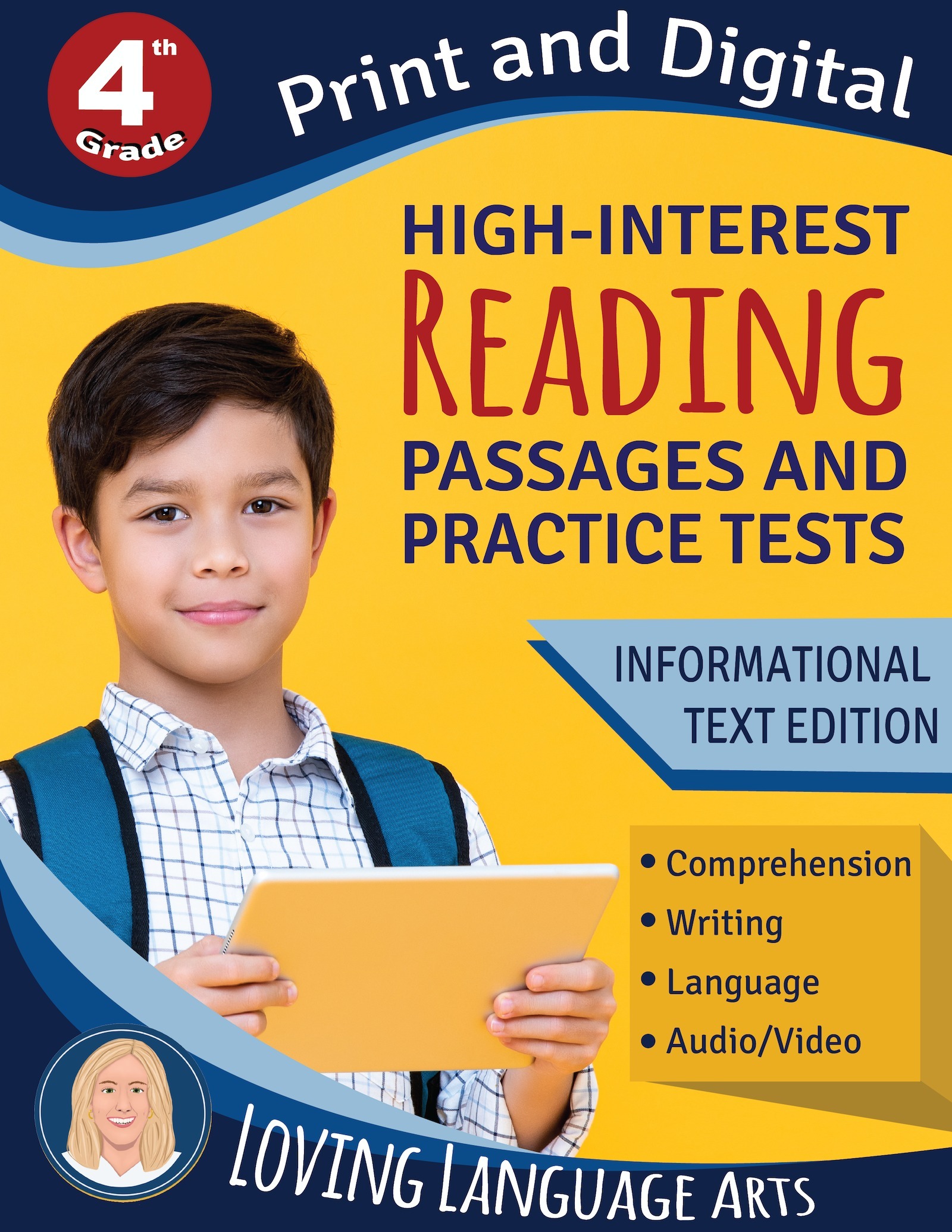
Grade 4 Reading Passages and Practice Tests Workbook - Informational Text Edition
Grade 10 Reading Passages and Practice Tests Workbook - Informational Text Edition
Grade 5 Reading Passages and Practice Tests Workbook - Informational Text Edition
Grade 11 Reading Passages and Practice Tests Workbook - Informational Text Edition
Grade 6 Reading Passages and Practice Tests Workbook - Informational Text Edition
Grade 12 Reading Passages and Practice Tests Workbook - Informational Text Edition
Grade 7 Reading Passages and Practice Tests Workbook - Informational Text Edition
we sail for america by samuel mcclure ela practice test

Try a Freebie!

Grade 8 Reading Passages and Practice Tests Workbook - Informational Text Edition
be ready to help passage and ela practice test free

Try a Freebie!

Grade 9 Reading Passages and Practice Tests Workbook - Informational Text Edition
why onions make you cry passage and practice test

Try a Freebie!

The 6th Grade Practice Tests Test Prep Workbook “is a high quality, beautifully-aligned resource. It is no-frills, to the point, yet high-interest for students. It is helping us prepare for standardized testing in a hybrid, synchronous, difficult year.”

ReBeckha L.

Sixth Grade Teacher, Teachers Pay Teachers

How about save this pin to your “Classroom Management” or “Teaching Middle School” Board so that you can come back to this post again?

pin for rule #2 teaching middle school
Did you miss Rule #1 for teaching middle school? Are you curious to see what Rule #3 is? Check them out!
pin for my rule #1 for teaching middle school
pin for blog post rule #3 for teaching middle school